 Bug FAQ
Common Eastern Firefly
Photinus pyralis · Order: Coleoptera · Family: Lampyridae
Also called: Big Dipper Firefly

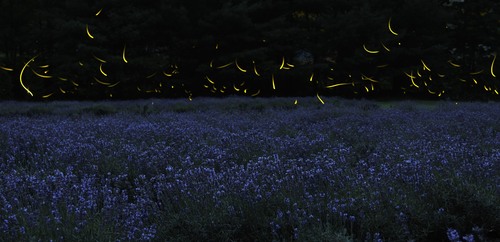
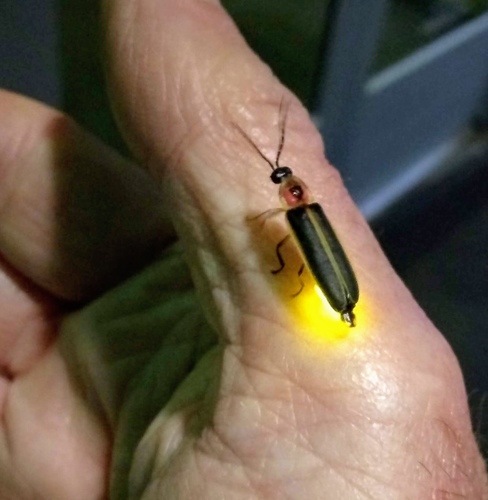
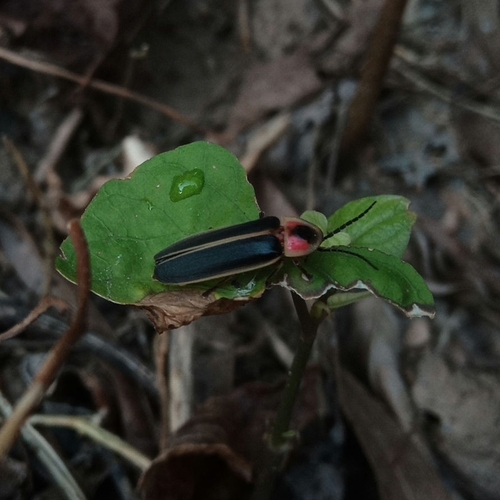
The common Eastern firefly is a small beetle about 9 to 19 mm long with a flat black or brown body, yellow-bordered wing covers, and a pale yellow head shield marked with a central black dot surrounded by pink or red. It lives in damp soils with long grasses across the eastern half of North America, where larvae eat worms, slugs and snails, and adults appear in spring and summer evenings, flashing light to attract mates.
Source: Wikipedia
How to recognize it
Body is flat black or brown; wing covers (elytra) run the length of the thorax and abdomen and have a yellow border. Head shield (pronotum) is pale yellow with a central black dot surrounded by pink or red.
Source: Wikipedia
Size
Adults measure between 9 and 19 mm (0.4 to 0.7 in) in length.
Source: Wikipedia
Where it lives
Found in many habitats from temperate to tropical areas, especially where soil is damp and grasses are long.
Source: Wikipedia
What it eats
Larvae live underground and feed on worms, slugs, and snails.
Source: Wikipedia
Life cycle
Development time varies; some individuals may spend up to two years as larvae before pupating. Adult emergence takes one to two weeks, after which the firefly lives another three weeks to two months, using its light to find mates.
Source: Wikipedia
When you see it
Adults are most noticeable at twilight during spring and summer.
Source: Wikipedia
Where it comes from
The species originated in Texas during the Miocene and later spread to central and northeastern United States.
Source: Wikipedia
Lookalikes
Often confused with fireflies of the genus Photuris, which also occur in North America.
Source: Wikipedia
Where it is found in the US
Recorded in 36 of 51 states and DC. Most records: North Carolina, Pennsylvania, Ohio, New York, Maryland, Texas, Illinois, Virginia.
Darker = more records. Counts are museum and citizen-science records, not population size.
Source: GBIF
Status: native in North America; native in Canada; native in United States. Source: iNaturalist
Months it is reported in the US
Source: GBIF
More photos

Questions people ask
How can I tell them apart from similar fireflies?
Check for the yellow-bordered elytra and the pale yellow pronotum with a central black dot surrounded by pink or red; these features differ from the related Photuris species.
Source: Wikipedia
Same family (Lampyridae)


Sources
- Wikipedia: https://en.wikipedia.org/wiki/Photinus_pyralis
Look it up elsewhere: GBIF · iNaturalist · BugGuide · ITIS · Wikipedia
Text written 2026-10-22 from the sources above and checked sentence by sentence against them. Data fetched 2026-10-22.