 Bug FAQ
Japanese Rhinoceros Beetle
Trypoxylus dichotomus · Order: Coleoptera · Family: Scarabaeidae
Also called: East Asian Rhinoceros Beetle, Japanese Horned Beetle, Mushi Beetle

They live in broad-leaf forests and mountainous areas across much of Asia and emerge as adults in summer.
Source: Wikipedia
How to recognize it
They have a dark brown-red colour that can look black without direct light. Males have a prominent horn on the head that can be up to one-third of their body length.
Source: Wikipedia
Size
Males are usually 40 to 80 mm long and females 35 to 60 mm. The male’s wing covers are 19 to 33 mm and the horn ranges from 7 to 32 mm.
Source: Wikipedia
Where it lives
They prefer broad-leaf forests in tropical or subtropical climates. They are also common in mountainous regions.
Source: Wikipedia
What it eats
Adults drink exposed tree sap. Larvae feed on soil humus.
Source: Wikipedia
Life cycle
Females lay eggs in soil humus from July to September. It takes about one year for the beetle to develop from egg to adult.
Source: Wikipedia
When you see it
Adults emerge from the ground between June and August.
Source: Wikipedia
Questions people ask
Are they a problem for my garden?
They feed on tree sap and soil humus, not on garden plants, so they are not a garden pest.
Source: Wikipedia
Same family (Scarabaeidae)
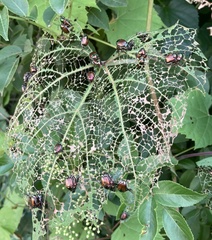 Japanese BeetlePopillia japonicaDamages trees, gardens or crops
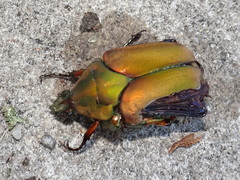 Common Green June BeetleCotinis nitidaDamages trees, gardens or crops
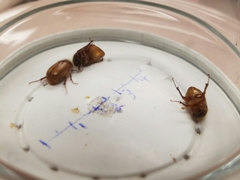 Phyllophaga crinitaPhyllophaga crinitaDamages trees, gardens or crops
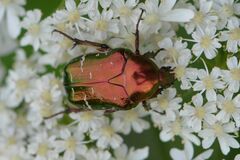 European Rose ChaferCetonia aurata
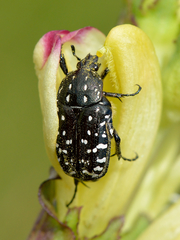 Mediterranean Spotted ChaferOxythyrea funestaDamages trees, gardens or crops
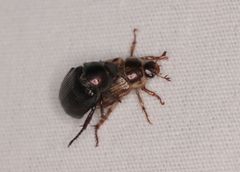 Oriental BeetleExomala orientalisDamages trees, gardens or crops
Sources
- Wikipedia: https://en.wikipedia.org/wiki/Japanese_rhinoceros_beetle
Look it up elsewhere: GBIF · iNaturalist · BugGuide · Wikipedia
Text written 2026-10-22 from the sources above and checked sentence by sentence against them. Data fetched 2026-10-22.