 Bug FAQ
Japanese giant weevil
Sipalinus gigas · Order: Coleoptera · Family: Dryophthoridae

Sipalinus gigas is a beetle that grows to about 12 to 30 mm long and has a brownish crusty coating with a moderately curved, punctured beak. It lives under the bark of dying or felled trees, where its larvae develop in dead or decaying wood, and it is native to parts of Asia and Australasia.
Source: Wikipedia
How to recognize it
The beetle’s surface is covered with a brownish crusty coating, its beak is moderately curved and punctured, the pronotum is longer than wide, and the elytra have dark brown stripes with whitish tubercle-bearing areas.
Source: Wikipedia
Size
Adults measure between 12 and 30 mm in length.
Source: Wikipedia
Where it lives
They are typically found under the bark of dying or recently cut trees, and the larvae live inside dead or decaying wood.
Source: Wikipedia
What it eats
Both adults and larvae feed on the wood of dead or dying trees.
Source: Wikipedia
Life cycle
The beetle’s life cycle is tied to dead or decaying trees, with larvae developing inside the wood before emerging as adults.
Source: Wikipedia
Where it comes from
The species occurs in Korea, China, Japan, the Himalayas, India, and across Australasia from the Philippines to New Guinea, the Solomon Islands, and eastern Australia.
Source: Wikipedia
More photos


Questions people ask
Where can I find Sipalinus gigas?
Look for them under the bark of dying or freshly felled trees, especially in their native Asian and Australasian range.
Source: Wikipedia
What does Sipalinus gigas look like?
It has a brownish crusty coating, a moderately curved punctured beak, a pronotum longer than wide, and elytra with dark brown stripes and whitish tubercles.
Source: Wikipedia
Same family (Dryophthoridae)
 Rice WeevilSitophilus oryzaeCan damage your home
 Wheat WeevilSitophilus granariusDamages trees, gardens or crops
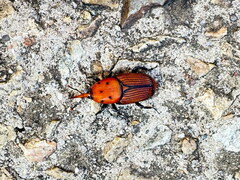 Red Palm WeevilRhynchophorus ferrugineusDamages trees, gardens or crops
 Cocklebur WeevilRhodobaenus quinquepunctatus
 South American Palm WeevilRhynchophorus palmarumDamages trees, gardens or crops
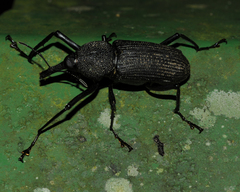 Bearded WeevilRhinostomus barbirostris
Sources
- Wikipedia: https://en.wikipedia.org/wiki/Sipalinus_gigas
Look it up elsewhere: GBIF · iNaturalist · BugGuide · ITIS · Wikipedia
Text written 2026-10-23 from the sources above and checked sentence by sentence against them. Data fetched 2026-10-23.