 Bug FAQ
Rice Weevil
Sitophilus oryzae · Order: Coleoptera · Family: Dryophthoridae
Also called: Lesser Rice Weevil
Source: Wikipedia

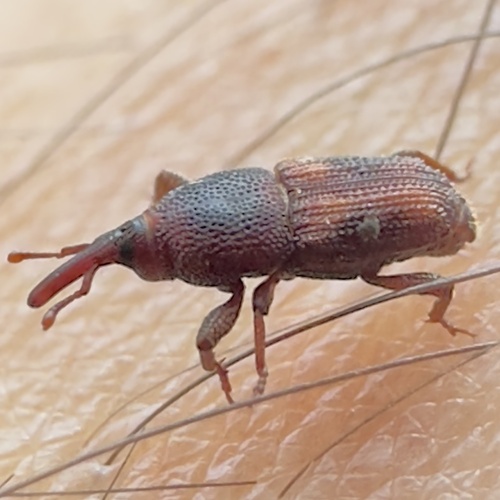
Adult rice weevils are tiny beetles about 3 to 4.6 mm long with a long snout and brown-black bodies marked by four orange-red spots on the wing covers. They infest stored grains like wheat, rice and maize, where the larvae eat the seed from inside, and can be eliminated by freezing or heating the contaminated food.
Source: Wikipedia
How to recognize it
Look for four orange-red spots arranged in a cross on the beetle’s wing covers; they are often mistaken for the similar maize weevil.
Source: Wikipedia
Size
Adults measure between 3 and 4.6 mm in length and have a pronounced snout.
Source: Wikipedia
Is it a pest in the house?
They infest pantry foods, so removing all contaminated grain and other stored products is essential to control them.
Source: Wikipedia
How to get rid of it
Freeze infested food below to 18 °C for three days or heat it to 60 °C for 15 minutes to kill every life stage. Eliminate all suspect food items from the kitchen to prevent reinfestation.
Source: Wikipedia
Where it lives
They are stored-product pests that live in grain stores and pantry supplies.
Source: Wikipedia
What it eats
Both adults and larvae feed on stored seeds such as wheat, rice and maize, with the larvae hollowing out the grain as they grow.
Source: Wikipedia
Life cycle
Adults can fly and may live up to two years; females lay 2 to 6 eggs each day, up to about 300 total, by boring a hole in a grain kernel. The egg hatches inside the grain, the larva feeds and pupates there, and the new adult emerges after a few days.
Source: Wikipedia
Lookalikes
They are often confused with maize weevils, which can be slightly larger but overlap in size with rice weevils.
Source: Wikipedia
Where it is found in the US
Recorded in 30 of 51 states and DC. Most records: Kentucky, New York, New Mexico, Texas, California, Pennsylvania, Kansas, Alaska.
Darker = more records. Counts are museum and citizen-science records, not population size.
Source: GBIF
Months it is reported in the US
Source: GBIF
More photos
Questions people ask
How can I tell a rice weevil from a maize weevil?
Check the wing covers for four orange-red spots in a cross pattern; rice weevils have this marking and are usually a bit smaller than maize weevils.
Source: Wikipedia
What should I do to get rid of rice weevils in my pantry?
Throw away any infested grain, then either freeze the remaining food below to 18 °C for three days or heat it to 60 °C for 15 minutes to kill any hidden insects.
Source: Wikipedia
Same family (Dryophthoridae)
 Wheat WeevilSitophilus granariusDamages trees, gardens or crops
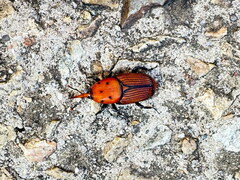 Red Palm WeevilRhynchophorus ferrugineusDamages trees, gardens or crops
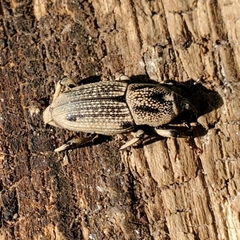 Hunting BillbugSphenophorus venatus
 Cocklebur WeevilRhodobaenus quinquepunctatus
 South American Palm WeevilRhynchophorus palmarumDamages trees, gardens or crops
 Ironweed CurculioRhodobaenus tredecimpunctatus
Sources
- Wikipedia: https://en.wikipedia.org/wiki/Rice_weevil
Look it up elsewhere: GBIF · iNaturalist · BugGuide · ITIS · Wikipedia
Text written 2026-10-23 from the sources above and checked sentence by sentence against them. Data fetched 2026-10-22.