 Bug FAQ
Indigo Dropwing
Trithemis festiva · Order: Odonata · Family: Libellulidae
Also called: Black Stream Glider

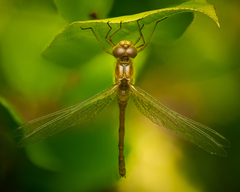
The indigo dropwing is a medium-sized dragonfly with a dark body that looks deep blue because of purple pruinescence. Males have a darker purplish-grey face, black legs, transparent wings with a brown mark at the hind-wing base and a black tip spot. It is common near slow-moving streams, canals and the plants that grow on their banks, and it ranges from Greece and Turkey across Asia to New Guinea.
Source: Wikipedia
How to recognize it
The male’s frontal area is a darker purplish-grey. The thorax is black with a purple bloom that makes it appear deep blue. Legs are black; wings are clear with a dark brown patch at the base of the hind wing and a black spot at the tip. The abdomen has a fine blue bloom.
Source: Wikipedia
Size
It is a medium-sized dragonfly.
Source: Wikipedia
Where it lives
It is usually seen near slow-flowing streams and canals, often in dense forest areas. It perches on the tips of aquatic or damp plants that grow along stream or river banks.
Source: Wikipedia
Where it comes from
Its distribution stretches from Greece, Cyprus and Turkey across Asia to New Guinea.
Source: Wikipedia
Lookalikes
The black stream glider (Trithemis festiva) is also called the indigo dropwing and belongs to the Libellulidae family.
Source: Wikipedia
Where it is found in the US
Recorded in 1 of 51 states and DC. Most records: Kansas.
Darker = more records. Counts are museum and citizen-science records, not population size.
Source: GBIF
Same family (Libellulidae)

Sources
- Wikipedia: https://en.wikipedia.org/wiki/Black_stream_glider
Look it up elsewhere: GBIF · iNaturalist · BugGuide · Wikipedia
Text written 2026-10-22 from the sources above and checked sentence by sentence against them. Data fetched 2026-10-22.