 Bug FAQ
Hylamorpha elegans
Hylamorpha elegans · Order: Coleoptera · Family: Scarabaeidae
Source: Wikipedia


The beetle is 12 to 18 mm long and 6 to 11 mm wide, with a long body. Adults are green with possible silver or bronze shine, and males have glossy green legs while females’ legs are less shiny. Larvae live in soil feeding on grass and cereal roots, and adults can strip leaves from Nothofagus trees, making it a serious agricultural and forest pest.
Source: Wikipedia
How to recognize it
The head, pronotum and wing covers range from light to dark green, sometimes showing shiny silver or bronze reflections, and males have all-green glossy legs while females have green legs with less shine.
Source: Wikipedia
Size
It measures about 11.8 to 18.2 mm in length and 5.8 to 10.8 mm across the shoulders.
Source: Wikipedia
How to get rid of it
Understanding their odorant-binding proteins and chemoreceptors helps identify chemicals that could be used for pest management.
Source: Wikipedia
Where it lives
It is native to South America, especially Chile and Argentina.
Source: Wikipedia
Life cycle
The larval stage develops in the soil’s root layer, and after mating females lay eggs on preferred host plants like red clover.
Source: Wikipedia
When you see it
The species is mainly nocturnal and is often seen foraging at night.
Source: Wikipedia
Where it comes from
Its native range is Chile and Argentina in South America.
Source: Wikipedia
More photos


Questions people ask
How can I manage Hylamorpha elegans?
Researchers are studying its odorant-binding proteins to find compounds that attract or repel it for better pest control.
Source: Wikipedia
Same family (Scarabaeidae)
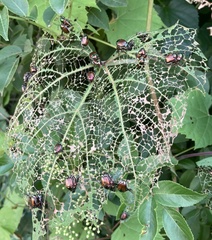 Japanese BeetlePopillia japonicaDamages trees, gardens or crops
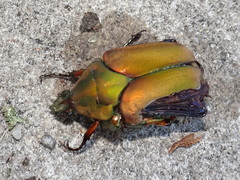 Common Green June BeetleCotinis nitidaDamages trees, gardens or crops
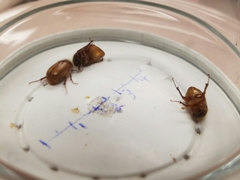 Phyllophaga crinitaPhyllophaga crinitaDamages trees, gardens or crops
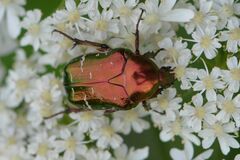 European Rose ChaferCetonia aurata
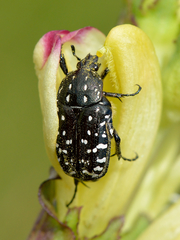 Mediterranean Spotted ChaferOxythyrea funestaDamages trees, gardens or crops
 Oriental BeetleExomala orientalisDamages trees, gardens or crops
Sources
- Wikipedia: https://en.wikipedia.org/wiki/Hylamorpha
Look it up elsewhere: GBIF · iNaturalist · BugGuide · Wikipedia
Text written 2026-10-23 from the sources above and checked sentence by sentence against them. Data fetched 2026-10-23.