 Bug FAQ
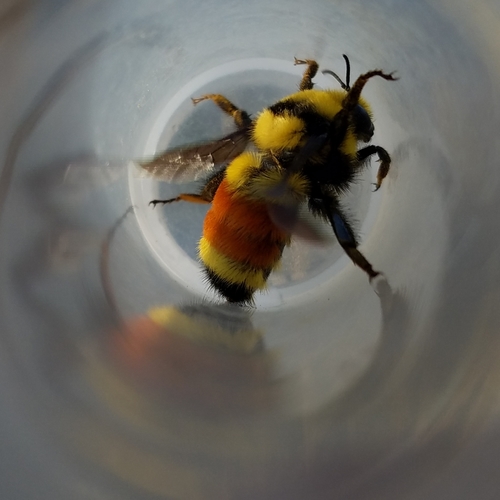
Hunt's Bumble Bee
Bombus huntii · Order: Hymenoptera · Family: Apidae
Also called: Hunt Bumble Bee

Hunt's bumblebee lives in desert scrub, prairies, meadows, and high-elevation pine areas in western North America, from Canada to Mexico. It nests underground, forms one-year colonies of queens, workers, and males, and feeds on a variety of wildflowers such as rabbitbrush, thistles, and sunflowers.
Source: Wikipedia
How to recognize it
It is commonly called Hunt's bumblebee.
Source: Wikipedia
Where it lives
It inhabits desert scrub, prairies, meadows, and pine ecosystems on high volcano tops.
Source: Wikipedia
Where it comes from
It is native to western North America, ranging from western Canada and the United States east to Ontario and Minnesota, and south to Mexico’s Trans-Mexican Volcanic Belt.
Source: Wikipedia
Lookalikes
Although its numbers have declined, it remains one of the more common western North American bees.
Source: Wikipedia
Where it is found in the US
Recorded in 35 of 51 states and DC. Most records: Colorado, Utah, Idaho, Washington, Oregon, Arizona, New Mexico, Wyoming.
Darker = more records. Counts are museum and citizen-science records, not population size.
Source: GBIF
Status: native in North America; native in Canada; native in United States. Source: iNaturalist
Months it is reported in the US
Source: GBIF
More photos


Same family (Apidae)


Sources
- Wikipedia: https://en.wikipedia.org/wiki/Bombus_huntii
Look it up elsewhere: GBIF · iNaturalist · BugGuide · ITIS · Wikipedia
Text written 2026-10-22 from the sources above and checked sentence by sentence against them. Data fetched 2026-10-22.