 Bug FAQ
Hawaiian Blue
Udara blackburni · Order: Lepidoptera · Family: Lycaenidae
Also called: Blackburn's Blue, Green Hawaiian Blue, koa blue

The Hawaiian blue butterfly has a wingspan of about an inch, roughly 22 to 29 mm. Its upper wings are blue while the undersides are green, and it lives only on several Hawaiian islands. Caterpillars feed on koa and a few other native plants, and adults sip flower nectar.
Source: Wikipedia
How to recognize it
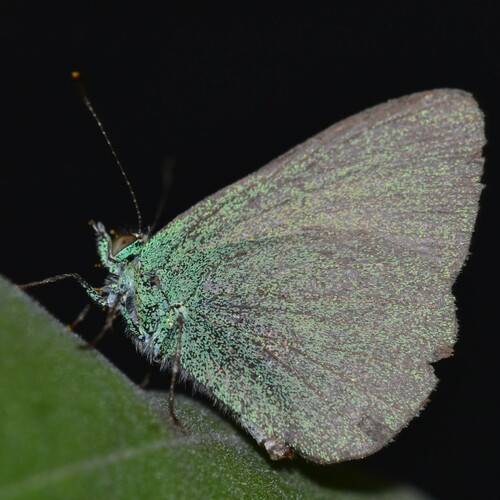
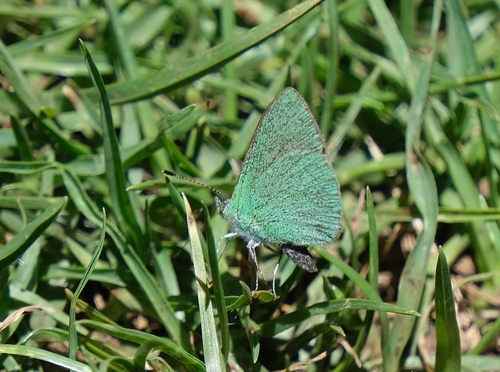
The upper side of the wings is blue and the underside is green.
Source: Wikipedia
Size
The wingspan ranges from 22 to 29 mm, about an inch.
Source: Wikipedia
Where it lives
It is endemic to Hawaii and has been recorded on Kauaʻi, Oʻahu, Maui, Molokai, Lanaʻi, and Hawaiʻi Island.
Source: Wikipedia
What it eats
Caterpillars mainly feed on koa trees and occasionally on ʻāaliʻi, olomea, and māmaki. Adult butterflies drink flower nectar with their long coiled proboscis.
Source: Wikipedia
Where it comes from
This species is native only to the Hawaiian islands listed above.
Source: Wikipedia
Where it is found in the US
Recorded in 1 of 51 states and DC. Most records: Hawaii.
Darker = more records. Counts are museum and citizen-science records, not population size.
Source: GBIF
Status: native in United States. Source: iNaturalist
Months it is reported in the US
Source: GBIF
More photos
Questions people ask
What colors are the wings of the Hawaiian blue butterfly?
The upper side of the wings is blue and the underside is green.
Source: Wikipedia
How big is the Hawaiian blue butterfly?
Its wingspan is about an inch, ranging from 22 to 29 mm.
Source: Wikipedia
Where can I find the Hawaiian blue butterfly?
It lives only on the Hawaiian islands of Kauaʻi, Oʻahu, Maui, Molokai, Lanaʻi, and Hawaiʻi Island.
Source: Wikipedia
What do the caterpillars of this butterfly eat?
They mainly feed on koa trees but will also eat ʻāaliʻi, olomea, and māmaki, as well as several other native plants.
Source: Wikipedia
Same family (Lycaenidae)






Sources
- Wikipedia: https://en.wikipedia.org/wiki/Udara_blackburni
Look it up elsewhere: GBIF · iNaturalist · BugGuide · ITIS · Wikipedia
Text written 2026-10-26 from the sources above and checked sentence by sentence against them. Data fetched 2026-10-26.