 Bug FAQ
Hairy-footed Flower Bee
Anthophora plumipes · Order: Hymenoptera · Family: Apidae
Also called: Spring Flower-Bee
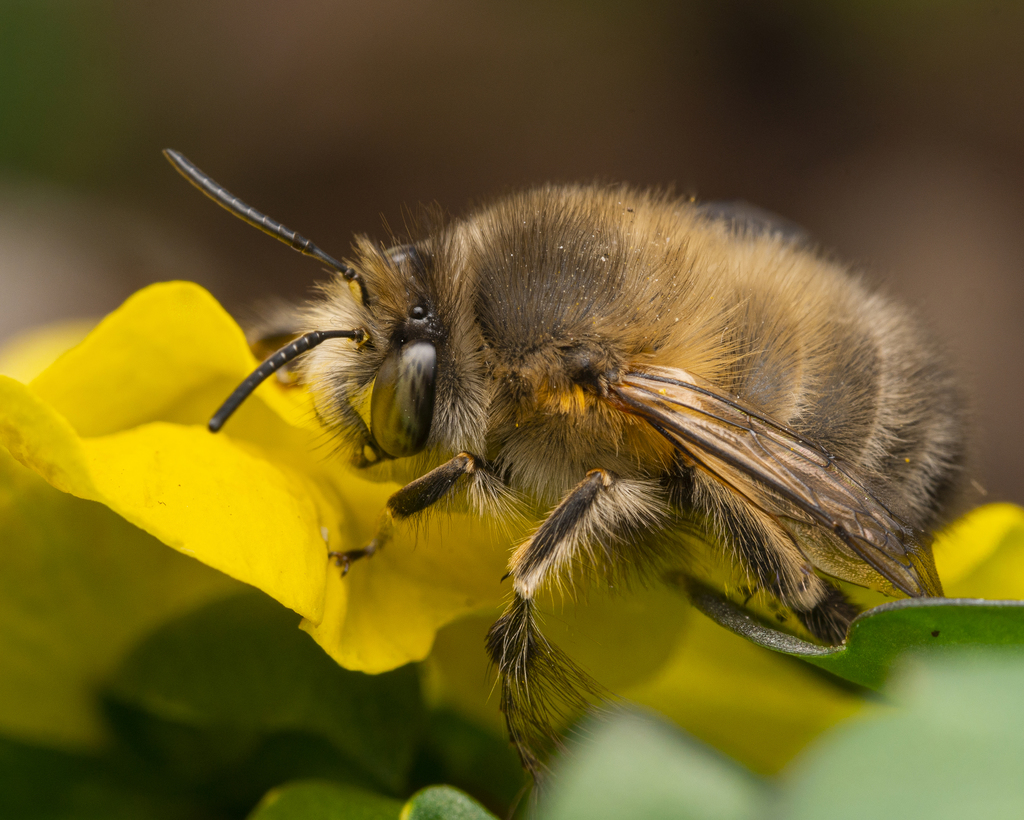
The hairy-footed flower bee is a small solitary bee about half an inch long (13 to 15 mm). Males are usually reddish-brown or gray, while females are dark with orange-red pollen-collecting hairs on the hind tibia. It lives in gardens, open woods and coastal areas across Europe, Asia and North Africa, and is seen from March to June feeding on early flowers and nesting in clay or mud walls.
Source: Wikipedia
How to recognize it
Males have bright reddish-brown or gray hair; females are all black or dark brown with orange-red scopal hairs on the hind tibia.
Source: Wikipedia
Size
Adults grow to about 13 to 15 mm (0.5 to 0.6 in) long.
Source: Wikipedia
Where it lives
They are common in gardens, open woodland and coastal sites.
Source: Wikipedia
What it eats
Adults are active March-June, feeding on nectar and pollen from early-flowering plants. Females dig nests in clay slopes or mud walls, stock cells with pollen and nectar, and lay a single egg on each pollen mass.
Source: Wikipedia
Life cycle
The species has one generation per year (univoltine). Females nest in clay or mud, fill cells with pollen and nectar, and lay one egg per cell.
Source: Wikipedia
When you see it
They can be seen from March through June.
Source: Wikipedia
Where it is found in the US
Recorded in 2 of 51 states and DC. Most records: Pennsylvania, Maryland.
Darker = more records. Counts are museum and citizen-science records, not population size.
Source: GBIF
Same family (Apidae)





Sources
- Wikipedia: https://en.wikipedia.org/wiki/Anthophora_plumipes
Look it up elsewhere: GBIF · iNaturalist · BugGuide · ITIS · Wikipedia
Text written 2026-10-22 from the sources above and checked sentence by sentence against them. Data fetched 2026-10-22.