 Bug FAQ
Hairy Dragonfly
Brachytron pratense · Order: Odonata · Family: Aeshnidae
Also called: Hairy Hawker

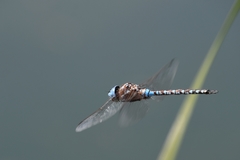
The hairy dragonfly is the United Kingdom's smallest hawker and has a hairy thorax that sets it apart from other species. It is about 5.5 cm long and lives near ponds, lakes, fens, ditches and canals that have plenty of vegetation and sunny open areas. Adults fly from mid-May to mid-July, catching flying insects in mid-air and then eating them on a perch.
Source: Wikipedia
How to recognize it
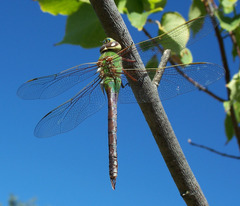
A hairy thorax distinguishes this dragonfly from other hawkers. It is the smallest hawker in the United Kingdom.
Source: Wikipedia
Size
Its body length is typically around 5.5 cm (2.2 in).
Source: Wikipedia
Where it lives
Open, sunny spots with dense vegetation are needed for protection.
Source: Wikipedia
What it eats
It hunts flying insects in mid-air. After catching prey it carries it to a perch to eat and digest.
Source: Wikipedia
Life cycle
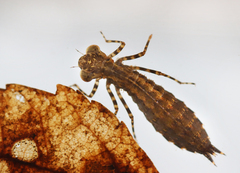
Adults are on the wing from mid-May to mid-July. Two years later the larvae emerge, climbing plant stems just above water or moving inland about a metre to spread their wings.
Source: Wikipedia
When you see it
The flight season runs from May to July. The species disappeared for a few years and has only recently returned.
Source: Wikipedia
Where it comes from
It is native to Europe and Asia Minor, extending east to the Caspian Sea.
Source: Wikipedia
More photos


Questions people ask
Where do they live?
They inhabit ponds, lakes, fens, ditches and canals with plenty of vegetation and sunny open areas.
Source: Wikipedia
Same family (Aeshnidae)


Sources
- Wikipedia: https://en.wikipedia.org/wiki/Hairy_dragonfly
Look it up elsewhere: GBIF · iNaturalist · BugGuide · Wikipedia
Text written 2026-10-23 from the sources above and checked sentence by sentence against them. Data fetched 2026-10-22.