 Bug FAQ
Green Hairstreak
Callophrys rubi · Order: Lepidoptera · Family: Lycaenidae
Also called: Green Hairstreak Butterfly, Stiallach uaine
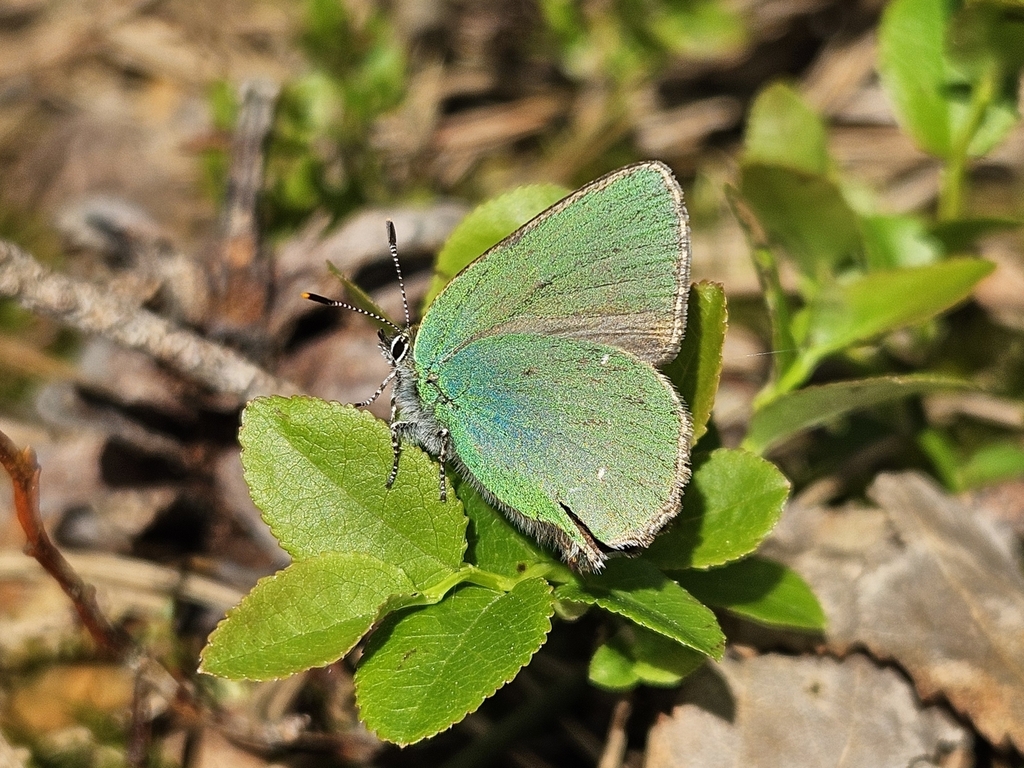
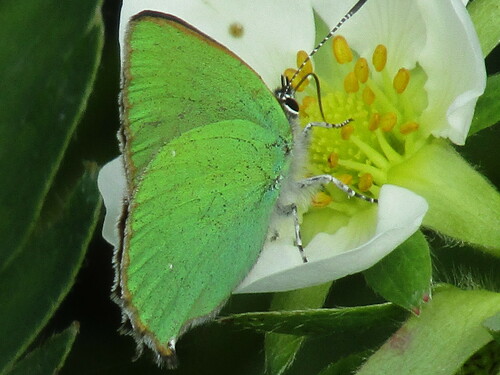
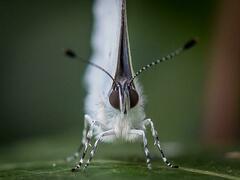
The green hairstreak is a small butterfly with a wingspan of about 26 to 30 mm. Its upper wings are dull brown, while the underside shines bright green with a thin white line that may be faint or missing.
Source: Wikipedia
How to recognize it
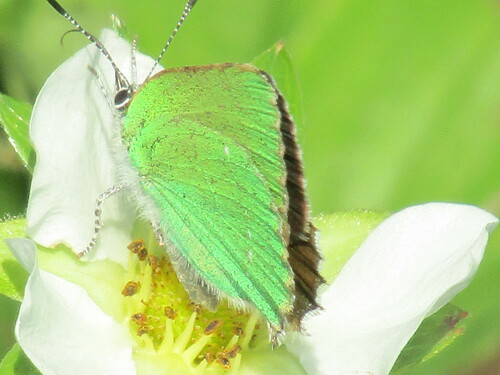
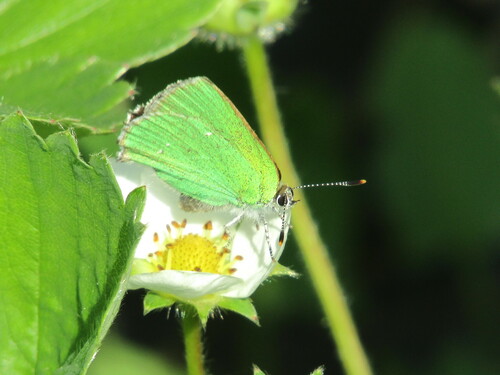
The top side of the wings is a uniform dull brown; males have two pale patches on the forewings made of scent scales. The underside is bright green with a thin white line that can appear as a faint row of dots or be absent.
Source: Wikipedia
Size
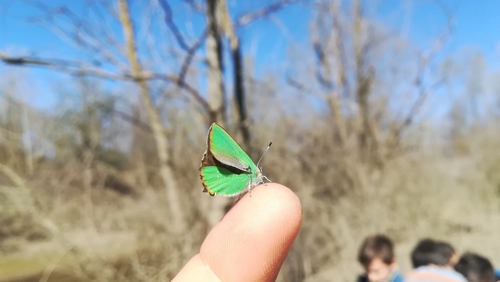
Wingspan ranges from 26 to 30 mm (about 1.0 to 1.2 in).
Source: Wikipedia
Where it lives
It lives in many habitats such as chalk downland, heathland, moorland, woodland clearings, wetlands, and dry meadows up to 2,300 m elevation.
Source: Wikipedia
What it eats
Caterpillars feed on a wide range of plants including bilberry, bog bilberry, birch, raspberry, vetch, various clovers, heather, buckthorn, currants, spirea, and sea buckthorn. Adults feed in June and autumn on papilionaceous plants like Sarothamnus, Genista, Cytisus, as well as oak, Vaccinium, and Sedum.
Source: Wikipedia
Life cycle
The species has one generation per year; eggs are laid singly and the larvae pupate on the ground, where the pupae can emit squeaks that attract ants.
Source: Wikipedia
When you see it
Adults are on the wing from late March through June, sometimes seen in July and early August.
Source: Wikipedia
Lookalikes
Like other lycaenids, the green hairstreak looks somewhat slug-like when at rest. The iridescent green underside is a structural colour created by microscopic diffraction gratings in the wing scales.
Source: Wikipedia
More photos
Same family (Lycaenidae)

Sources
- Wikipedia: https://en.wikipedia.org/wiki/Green_hairstreak
Look it up elsewhere: GBIF · iNaturalist · BugGuide · Wikipedia
Text written 2026-10-22 from the sources above and checked sentence by sentence against them. Data fetched 2026-10-22.