 Bug FAQ
Green-eyed Flower Bee
Anthophora bimaculata · Order: Hymenoptera · Family: Apidae
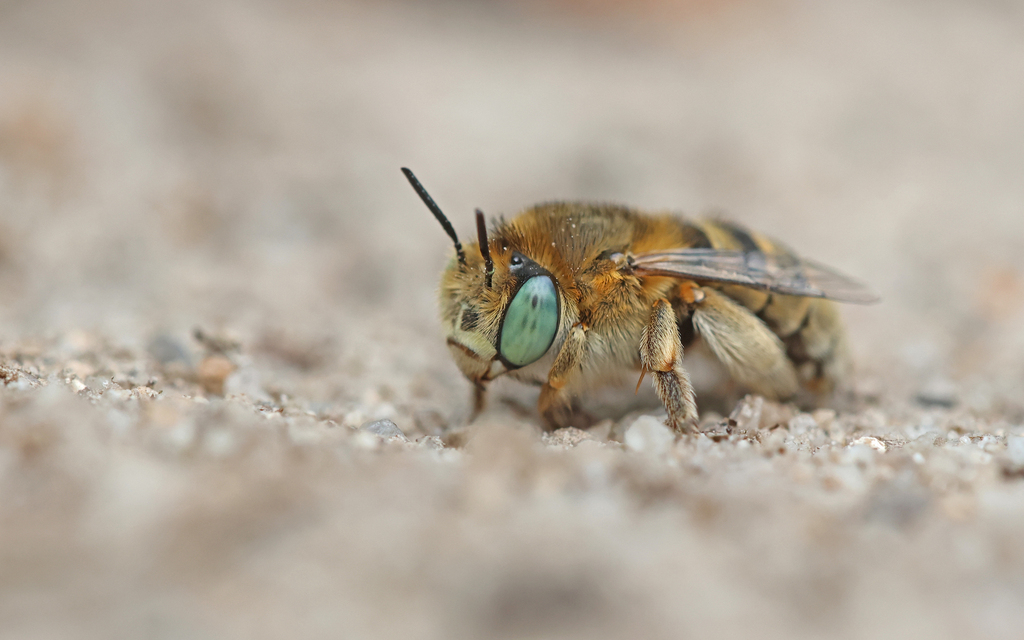
Green-eyed Flower Bees are small solitary bees about 8 to 9 mm long that nest in fine sandy soils in low-lying open habitats. They are active from early July to late August, collect pollen from a wide range of wildflowers, and are found from North Africa across much of Europe into Central Asia.
Source: Wikipedia
How to recognize it
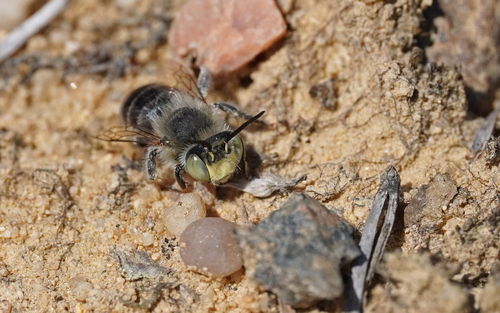
Males have narrow light bands on the abdomen, a yellow face and noticeably hairy middle legs. Females show a yellow clypeus with two large black spots at the base, and the fourth and fifth abdominal segments have gray-yellow fuzzy hairs. Both sexes have olive-green compound eyes and produce a loud, high-pitched flight buzz.
Source: Wikipedia
Size
They are about 8 to 9 mm long.
Source: Wikipedia
Where it lives
They nest in fine to medium sand in low-lying sandy places such as inland dunes, drifting sand fields, sand pits, sandy embankments, ruderal sites, forest edges and clearings, usually on flat, vegetation-free surfaces or small margins.
Source: Wikipedia
What it eats
They collect pollen from many plant families, known sources include knapweeds and thistles (Centaurea scabiosa, C. stoebe, Cirsium vulgare, Picris hieracioides, Hypochaeris radicata), viper’s-bugloss (Echium vulgare), bugloss (Anchusa officinalis), meadow clover (Trifolium arvense), St John’s-wort (Hypericum perforatum), germander (Teucrium scorodonia), purple loosestrife (Lythrum salicaria) and alpine cinquefoil (Potentilla incana).
Source: Wikipedia
Life cycle
They have one generation per year, flying from early July to late August, and spend the winter as resting larvae.
Source: Wikipedia
Where it comes from
Their range extends from Morocco through Libya in North Africa, across Portugal, southern, central and eastern Europe, Ukraine, southern Russia to eastern Siberia, and through Asia Minor, the Caucasus to Iran and Kyrgyzstan; they have also been recorded as far north as central England, Denmark and Latvia, and as far south as Sicily, Corsica, Albania and Bulgaria.
Source: Wikipedia
Lookalikes
Ammobates punctatus and Coelioxys rufescens are cuckoo bees that parasitise them, and in England Coelioxys elongata has also been seen on their nests.
Source: Wikipedia
More photos
Questions people ask
How can I tell male and female Green-eyed Flower Bees apart?
Males have narrow light bands on the abdomen, a yellow face and hairy middle legs, while females have a yellow clypeus with two black spots and gray-yellow fuzzy hairs on abdominal segments 4 and 5.
Source: Wikipedia
When are Green-eyed Flower Bees active?
They fly from the beginning of July until the end of August.
Source: Wikipedia
What kind of places do they nest in?
They nest in fine to medium sand on flat, vegetation-free surfaces in low-lying sandy habitats such as dunes, sand pits and forest clearings.
Source: Wikipedia
What flowers do they visit for pollen?
They gather pollen from a variety of wildflowers including knapweeds, thistles, viper’s-bugloss, bugloss, meadow clover, St John’s-wort, germander, purple loosestrife and alpine cinquefoil.
Source: Wikipedia
Same family (Apidae)


Sources
- Wikipedia: https://en.wikipedia.org/wiki/Anthophora_bimaculata
Look it up elsewhere: GBIF · iNaturalist · BugGuide · ITIS · Wikipedia
Text written 2026-10-23 from the sources above and checked sentence by sentence against them. Data fetched 2026-10-23.