 Bug FAQ
Green Comma
Polygonia faunus · Order: Lepidoptera · Family: Nymphalidae
Also called: Faunus Anglewing

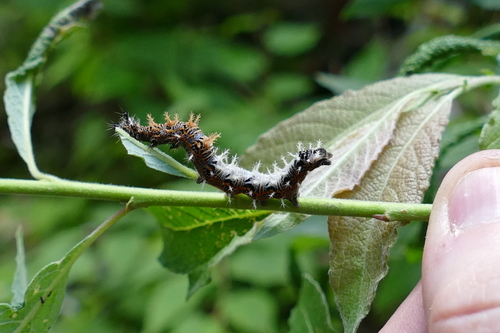
The green comma butterfly has a wingspan of about 45 to 64 mm and reddish-brown upper wings with wide dark borders. It lives in forested and mountainous areas near streams across boreal North America from Alaska to New Mexico and the Great Lakes to New England. Females lay eggs on host-plant leaves and the larvae feed on willow, birch, alder, rhododendron and currants.
Source: Wikipedia
How to recognize it
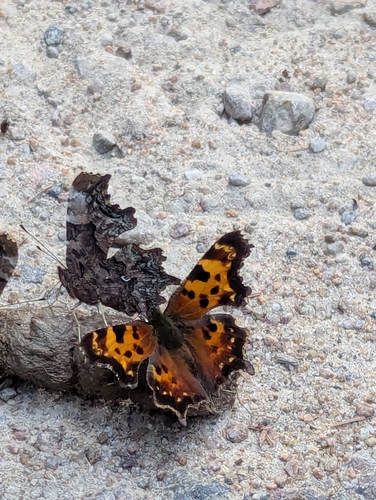
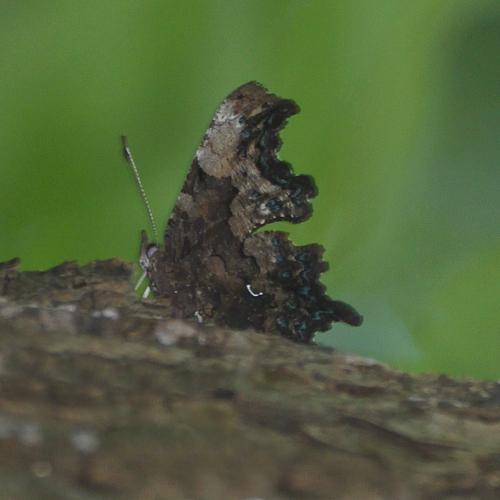
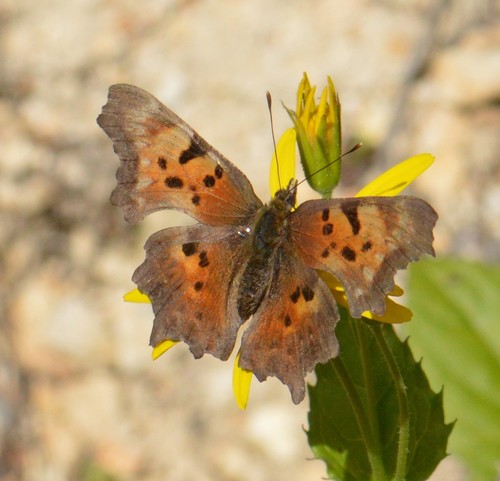
Upper wings are reddish brown with wide dark borders, while the underside is grey-brown with lighter outer half and greenish submarginal spots in males.
Source: Wikipedia
Size
Wingspan ranges from about 45 to 64 mm.
Source: Wikipedia
What it eats
Larvae feed on a variety of plants, especially upland willow, Betula lenta, alder, western rhododendron and Ribes species.
Source: Wikipedia
Life cycle
The species has one generation per year and adults are on the wing from May to September, varying by location. Adults overwinter and reappear in the following spring.
Source: Wikipedia
When you see it
One generation per year, flying from May to September depending on region.
Source: Wikipedia
Where it comes from
Also present around the Great Lakes, New England, the Maritimes and the southern Appalachians.
Source: Wikipedia
Lookalikes
Most similar to the eastern comma but can be told apart by irregular wing margins and a row of green spots on the underside. Closely related to the comma butterfly (Polygonia c-album) based on larval development and synapomorphies.
Source: Wikipedia
Where it is found in the US
Recorded in 27 of 51 states and DC. Most records: Alaska, New Hampshire, Washington, Idaho, Montana, Oregon, Vermont, Wyoming.
Darker = more records. Counts are museum and citizen-science records, not population size.
Source: GBIF
Status: native in North America; native in Canada; native in United States. Source: iNaturalist
Months it is reported in the US
Source: GBIF
More photos
Same family (Nymphalidae)






Sources
- Wikipedia: https://en.wikipedia.org/wiki/Polygonia_faunus
Look it up elsewhere: GBIF · iNaturalist · BugGuide · ITIS · Wikipedia
Text written 2026-10-22 from the sources above and checked sentence by sentence against them. Data fetched 2026-10-22.