 Bug FAQ
Golden Northern Bumble Bee
Bombus fervidus · Order: Hymenoptera · Family: Apidae
Also called: Yellow Bumble Bee, Yellow Bumblebee
Source: Wikipedia

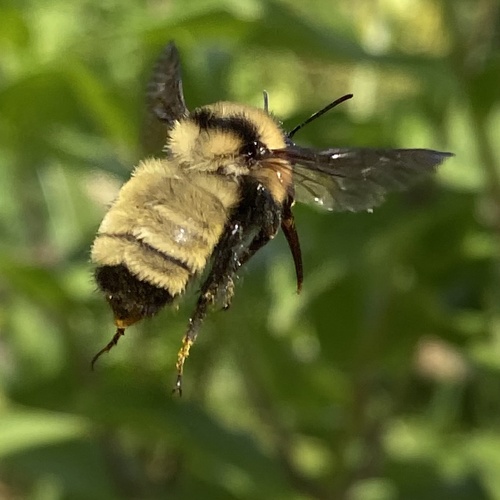
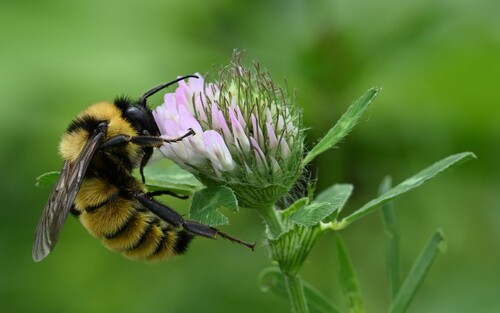
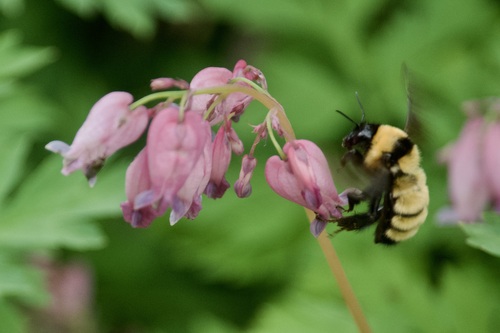
Bombus fervidus is a medium-sized bumble bee about 13 to 16 mm long, with a yellow abdomen and thorax. It lives in temperate savannas, grasslands, suburbs and farms, especially in the Northeastern United States.
Source: Wikipedia
How to recognize it
The bee has a yellow-colored abdomen and thorax, with the first four abdominal segments also yellow.
Source: Wikipedia
Does it bite or sting?
When threatened, this bee will sting a human immediately as a defense. Mature adults leave the nest to sting and bite any predator or attacker.
Source: Wikipedia
Where it lives
It prefers temperate savanna, grassland and tall-grass areas and can thrive in suburban and agricultural settings. Populations are common in cities and farmland, especially in the Northeastern U.S.
Source: Wikipedia
What it eats
Adults feed mainly on flower nectar, while the brood are fed pollen.
Source: Wikipedia
Life cycle
Males and new queens mate in the fall before the weather cools. After mating, queens hibernate underground through winter; all other bees die.
Source: Wikipedia
When you see it
Colony breeding takes place during the summer months.
Source: Wikipedia
Where it comes from
Bombus fervidus is native to North America, found in Canada, the United States and Mexico.
Source: Wikipedia
Lookalikes
It resembles its sibling Bombus californicus and can also be confused with Bombus pensylvanicus or Bombus auricomus. Males have slightly more yellow on the abdomen, making them hard to tell apart from B. pensylvanicus and B. californicus.
Source: Wikipedia
Where it is found in the US
Recorded in 48 of 51 states and DC. Most records: Oregon, Utah, Colorado, Pennsylvania, Illinois, Minnesota, Washington, New York.
Darker = more records. Counts are museum and citizen-science records, not population size.
Source: GBIF
Status: native in North America; native in United States; native in Canada. Source: iNaturalist
Months it is reported in the US
Source: GBIF
More photos

Questions people ask
Does the golden northern bumble bee bite or sting?
It will sting when it feels threatened; biting is not a typical behavior.
Source: Wikipedia
Where can I find this bee?
Look for it in temperate savannas, grasslands, suburbs and farms, especially in the Northeastern United States.
Source: Wikipedia
What does it eat?
Adults sip nectar from flowers, and they feed pollen to their larvae.
Source: Wikipedia
Same family (Apidae)


Sources
- Wikipedia: https://en.wikipedia.org/wiki/Bombus_fervidus
Look it up elsewhere: GBIF · iNaturalist · BugGuide · ITIS · Wikipedia
Text written 2026-10-22 from the sources above and checked sentence by sentence against them. Data fetched 2026-10-22.