 Bug FAQ
Golden Digger Wasp
Sphex funerarius · Order: Hymenoptera · Family: Sphecidae
Also called: European Golden Digger Wasp
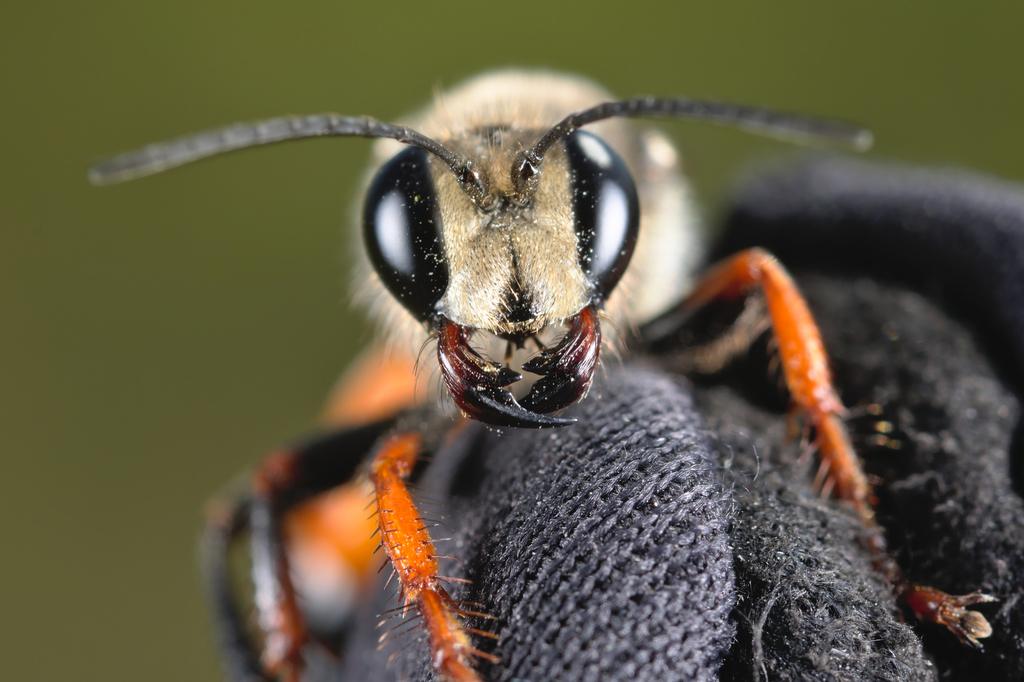
The golden digger wasp grows to about 15 to 23 mm long and is black with a bright orange-red band on the front part of its abdomen; its wings are yellowish with darker tips on the front wings. Females dig solitary nests in the ground, stock them with paralyzed grasshoppers for their larvae, and the adults feed on flower nectar in July and August.
Source: Wikipedia
How to recognize it
They are black with a large orange-red band on the anterior abdomen and have yellowish wings with darkened tops on the front wings.
Source: Wikipedia
Size
Adults reach a length of 15 to 23 mm (0.59 to 0.91 in).
Source: Wikipedia
Where it lives
These wasps are solitary ground-nesters.
Source: Wikipedia
What it eats
Larvae are provided with living insects that the female paralyzes and carries to the nest. Adults drink nectar from flowers such as those in the Apiaceae and Euphorbiaceae families during July and August.
Source: Wikipedia
Life cycle
A female stores several grasshoppers in her underground nest for the developing larvae. Eggs hatch after three to four days and the larvae are fully grown about 18 days later.
Source: Wikipedia
When you see it
Adults are active and can be seen flying in July and August.
Source: Wikipedia
Where it comes from
They occur in southern and central Europe and extend eastward into Central Asia.
Source: Wikipedia
More photos
Same family (Sphecidae)
 Yellow-legged Mud-dauber WaspSceliphron caementariumCan sting
 Common Blue Mud-dauber WaspChalybion californicumCan sting
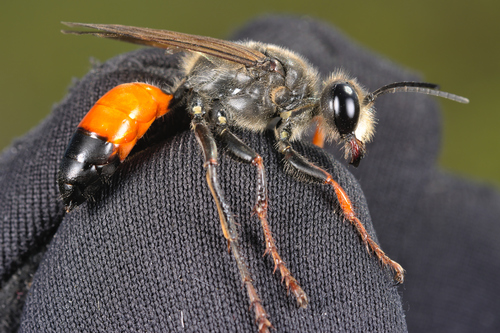
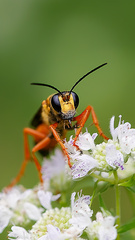 Great Golden Digger WaspSphex ichneumoneus
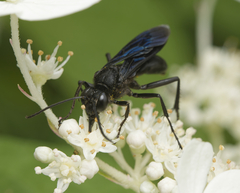 Great Black Digger WaspSphex pensylvanicusCan sting
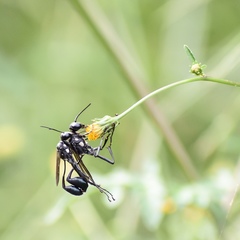 Gold-marked Thread-waisted WaspEremnophila aureonotata
 Mexican Grass-carrying WaspIsodontia mexicana
Sources
- Wikipedia: https://en.wikipedia.org/wiki/Sphex_funerarius
Look it up elsewhere: GBIF · iNaturalist · BugGuide · ITIS · Wikipedia
Text written 2026-10-22 from the sources above and checked sentence by sentence against them. Data fetched 2026-10-22.