 Bug FAQ
Gold-dust Weevil
Hypomeces pulviger · Order: Coleoptera · Family: Curculionidae
Source: Wikipedia


The gold-dust weevil is about 14 mm long and covered in iridescent green-yellow dust-like scales. Both larvae and adults feed on plants, with larvae feeding on roots in the soil and adults chewing foliage, often defoliating young bushes and nursery trees.
Source: Wikipedia
How to recognize it
The beetle’s body is covered in iridescent green or yellow-green dust-like scales. Its thorax and wing cases are grey and dusted with golden or greenish flattened setae.
Source: Wikipedia
Size
Adults measure roughly 14 mm (0.6 in) in length.
Source: Wikipedia
Is it a pest in the house?
Both life stages can cause damage to crops and young trees in forest nurseries.
Source: Wikipedia
Where it lives
It is found in forests, open areas and agricultural fields.
Source: Wikipedia
What it eats
Both larvae and adults are considered crop pests. Larvae live in soil where they feed on living plant roots.
Source: Wikipedia
Life cycle
Larvae develop in the soil, feeding on roots before pupating. Adult weevils live long enough to damage foliage and can defoliate young bushes and nursery trees.
Source: Wikipedia
Questions people ask
How does the gold-dust weevil damage plants?
Larvae feed on plant roots in the soil, while adults chew foliage and can strip leaves from young bushes and nursery trees.
Source: Wikipedia
Where might I find a gold-dust weevil?
They occur in forests, open areas and agricultural fields throughout southeastern Asia from Pakistan and India to Japan and Indonesia.
Source: Wikipedia
Same family (Curculionidae)
 Green Immigrant Leaf WeevilPolydrusus formosusDamages trees, gardens or crops
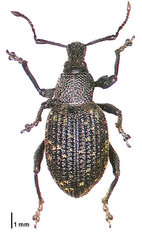 Black Vine WeevilOtiorhynchus sulcatusDamages trees, gardens or crops
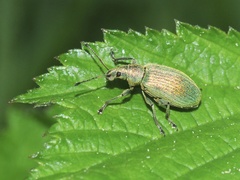 Nettle weevilPhyllobius pomaceusDamages trees, gardens or crops
 Asian Oak WeevilCyrtepistomus castaneusDamages trees, gardens or crops
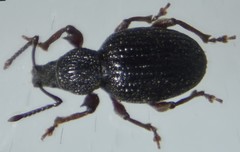 Strawberry Root WeevilOtiorhynchus ovatusDamages trees, gardens or crops
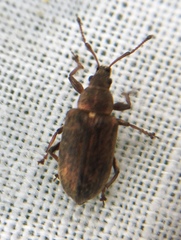 Common Leaf WeevilPhyllobius pyriDamages trees, gardens or crops
Sources
- Wikipedia: https://en.wikipedia.org/wiki/Hypomeces_pulviger
Look it up elsewhere: GBIF · iNaturalist · BugGuide · Wikipedia
Text written 2026-10-23 from the sources above and checked sentence by sentence against them. Data fetched 2026-10-22.