 Bug FAQ
Giant Forest Scorpion
Gigantometrus swammerdami · Order: Scorpiones · Family: Scorpionidae
Source: Wikipedia

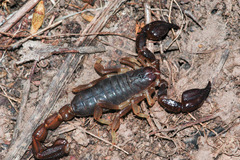
The giant forest scorpion is reddish-brown to reddish-black, with lobed claws covered in rounded bumps. It lives in tropical rainforests and warm areas, often found in termite mounds, tree holes, or abandoned animal burrows in agricultural fields. Males emerge from their dens in the summer months of April to July.
Source: Wikipedia
How to recognize it
Adults range from uniform reddish brown to reddish black, while juveniles are reddish with a yellow stinger. Their pincers are strongly lobed and completely covered with large rounded bumps.
Source: Wikipedia
Where it lives
They are commonly seen in tropical rainforests and other moderately warm climates.
Source: Wikipedia
When you see it
Males are usually active from April to July in the summer.
Source: Wikipedia
Where it comes from
This species is native to India.
Source: Wikipedia
More photos


Questions people ask
Can the giant forest scorpion sting people?
Yes, it can sting, but the sting is usually mild and not lethal.
Source: Wikipedia
When are male giant forest scorpions active?
Males are active in the summer months from April through July.
Source: Wikipedia
Where is the giant forest scorpion found?
It is native to India and lives in tropical rainforests and warm habitats, often in termite mounds, tree holes, or abandoned animal burrows.
Source: Wikipedia
What does the giant forest scorpion look like?
Adults are reddish brown to reddish black; juveniles are reddish with a yellow stinger, and their claws are lobed and covered in rounded bumps.
Source: Wikipedia
Same family (Scorpionidae)


Sources
- Wikipedia: https://en.wikipedia.org/wiki/Gigantometrus_swammerdami
Look it up elsewhere: GBIF · iNaturalist · BugGuide · Wikipedia
Text written 2026-10-23 from the sources above and checked sentence by sentence against them. Data fetched 2026-10-23.