 Bug FAQ
Black rock scorpion
Urodacus manicatus · Order: Scorpiones · Family: Scorpionidae
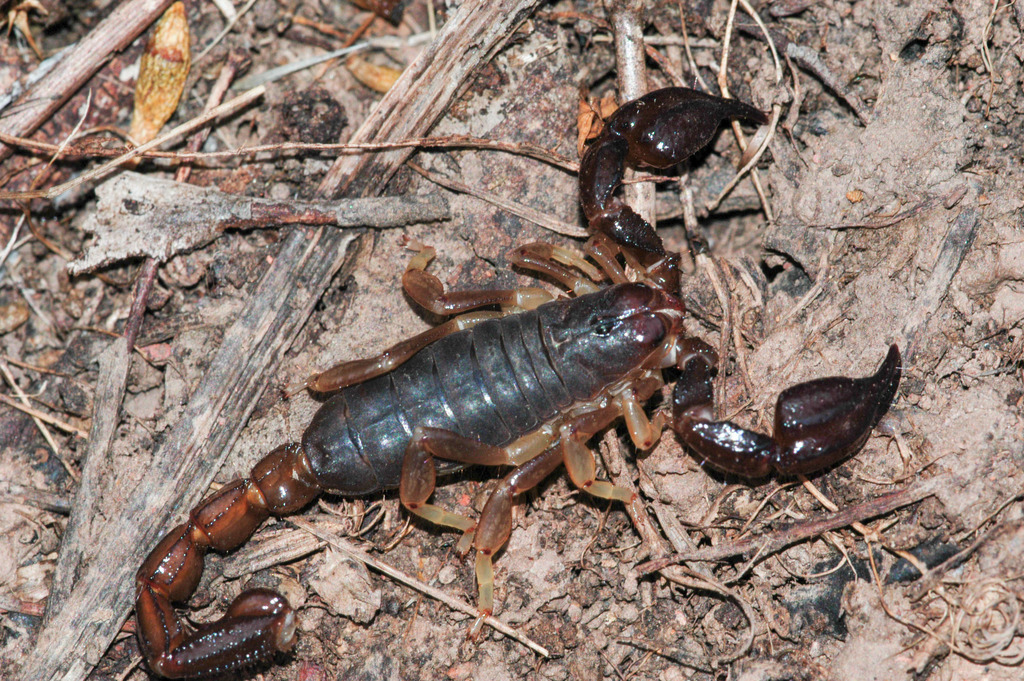
The black rock scorpion grows up to about 5.5 cm (2.2 in) and is dark brown or black. It lives on granite outcrops in open forest and is native to eastern Australia. It hunts insects, beetles, millipedes, centipedes, spiders and occasionally earthworms.
Source: Wikipedia
How to recognize it
The scorpion’s body is dark brown or black.
Source: Wikipedia
Size
It can reach a length of about 5.5 cm (2.2 in).
Source: Wikipedia
Does it bite or sting?
A peptide in the venom activates pain receptors, producing acute pain and heightened sensitivity without causing inflammation.
Source: Wikipedia
Where it lives
It prefers granite outcrops within open forest areas.
Source: Wikipedia
Life cycle
Wild populations may be declining because people collect them for the pet trade.
Source: Wikipedia
Where it comes from
It is found in eastern Australia.
Source: Wikipedia
Lookalikes
It was first described in 1876 as Ioctonus manicatus by Tamerlan Thorell. In 1888 Reginald Innes Pocock mistakenly named a specimen U. abruptus.
Source: Wikipedia
Questions people ask
Where is this scorpion found?
It lives on granite outcrops in open forests of eastern Australia.
Source: Wikipedia
Same family (Scorpionidae)


Sources
- Wikipedia: https://en.wikipedia.org/wiki/Urodacus_manicatus
Look it up elsewhere: GBIF · iNaturalist · BugGuide · Wikipedia
Text written 2026-10-23 from the sources above and checked sentence by sentence against them. Data fetched 2026-10-23.