 Bug FAQ
Giant African Mantis
Sphodromantis viridis · Order: Mantodea · Family: Mantidae
Also called: African mantis, bush mantis

Adult African mantises can be up to 10 cm long, with females much larger than the smaller males.
Source: Wikipedia
How to recognize it
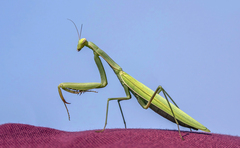
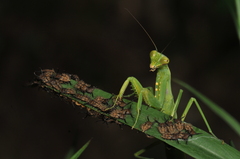
Adults show a white spot on each wing and a yellowish inner fore-leg that distinguishes them from the European mantis. Their body colour ranges from bright green to dull brown despite the name “viridis” meaning green.
Source: Wikipedia
Size
Females can reach about 10 cm (3.9 in) in length, while males are considerably smaller.
Source: Wikipedia
Where it lives
They tolerate a wide range of humidity and temperature better than many other mantis species.
Source: Wikipedia
What it eats
They readily accept prey of their own size as well as pieces of meat offered on tweezers.
Source: Wikipedia
Life cycle
A female lays an ootheca a few days after mating and can produce several during her life. Each ootheca may hatch up to 300 nymphs.
Source: Wikipedia
Where it comes from
They have become established outside their native range, including Israel and Spain.
Source: Wikipedia
Lookalikes
The name “African mantis” is also used for other Sphodromantis species and for Miomantis caffra.
Source: Wikipedia
Where it is found in the US
Recorded in 1 of 51 states and DC. Most records: Arizona.
Darker = more records. Counts are museum and citizen-science records, not population size.
Source: GBIF
More photos

Questions people ask
How can I tell an African mantis apart from a European mantis?
Look for a white spot on each wing and a yellowish inner fore-leg; the European mantis has black eyespots and white dots instead.
Source: Wikipedia
What size can a female African mantis reach?
Females can grow up to about 10 cm (3.9 in) long.
Source: Wikipedia
Same family (Mantidae)


Sources
- Wikipedia: https://en.wikipedia.org/wiki/Sphodromantis_viridis
Look it up elsewhere: GBIF · iNaturalist · BugGuide · Wikipedia
Text written 2026-10-23 from the sources above and checked sentence by sentence against them. Data fetched 2026-10-22.