 Bug FAQ
Geranium Bronze
Cacyreus marshalli · Order: Lepidoptera · Family: Lycaenidae
Also called: Common Geranium Bronze, Pelargonium Butterfly
Source: Wikipedia
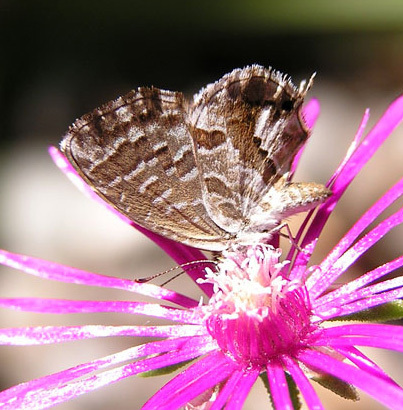
The geranium bronze is a small butterfly with brown-bronze wings edged in white and a patterned grey-brown underside. Its larvae live inside geranium and pelargonium plants, feeding on buds, young leaves and soft stems, making it a garden pest.
Source: Wikipedia
Size
Males have a wingspan of 15 to 23 mm; females are slightly larger at 18 to 23 mm.
Source: Wikipedia
Is it a pest in the house?
The butterfly is a serious pest to cultivated geranium and pelargonium plants, threatening garden health in Europe.
Source: Wikipedia
How to get rid of it
Research shows Bacillus thuringiensis, diflubenzuron and flufenoxuron can be effective against it.
Source: Wikipedia
Where it lives
It is a pest of cultivated Pelargonium and Geranium species and flies only short distances, resting frequently.
Source: Wikipedia
Life cycle
Adults fly briefly and rest often; larvae are endophytic, living inside the host plant for most of their development.
Source: Wikipedia
When you see it
Adults are active for short periods and spend much time resting.
Source: Wikipedia
Lookalikes
Males and females look alike.
Source: Wikipedia
More photos


Questions people ask
How can I get rid of geranium bronze larvae in my garden?
Biological controls like Bacillus thuringiensis and insecticides such as diflubenzuron or flufenoxuron have been shown to work.
Source: Wikipedia
What plants does it damage?
It feeds on and damages geranium and pelargonium plants, especially their buds, young leaves and soft stems.
Source: Wikipedia
Same family (Lycaenidae)





Sources
- Wikipedia: https://en.wikipedia.org/wiki/Geranium_bronze
Look it up elsewhere: GBIF · iNaturalist · BugGuide · Wikipedia
Text written 2026-10-22 from the sources above and checked sentence by sentence against them. Data fetched 2026-10-22.