 Bug FAQ
Galápagos centipede
Scolopendra galapagoensis · Order: Scolopendromorpha · Family: Scolopendridae
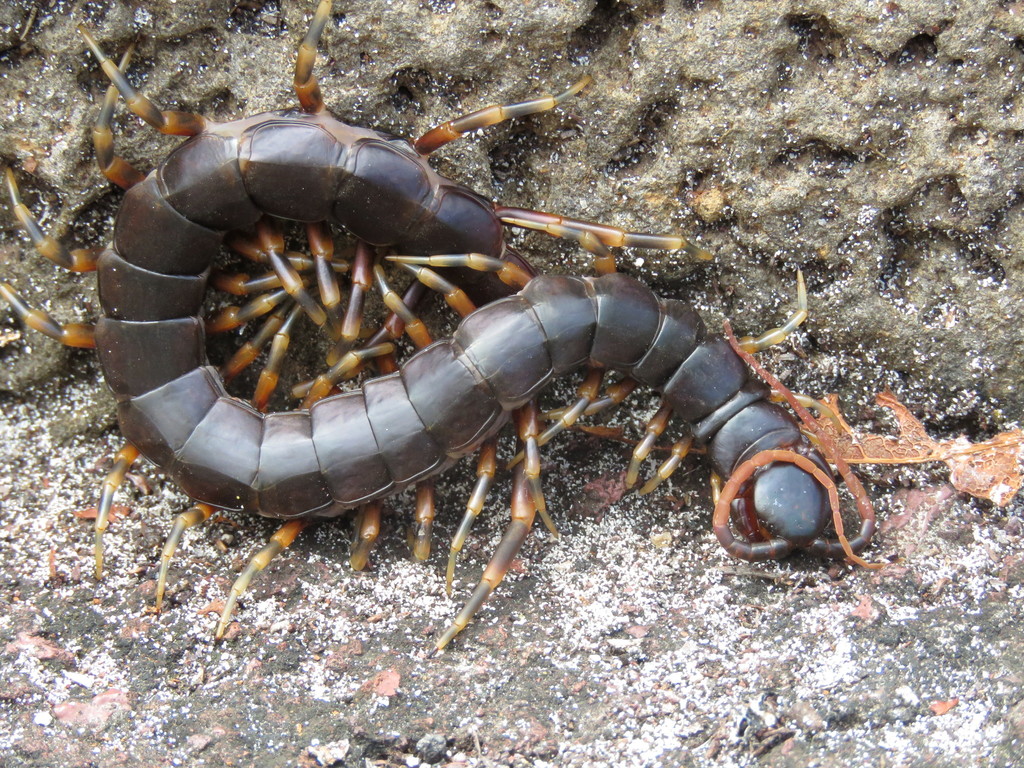
The Galápagos centipede can grow up to about 30 cm long, making it one of the world’s largest centipedes. It preys on crickets, newborn rodents, the Galápagos rice rat and even a Floreana Racer snake. Birds of prey such as the Galápagos hawk, mockingbirds and the common black rat hunt this centipede.
Source: Wikipedia
How to recognize it
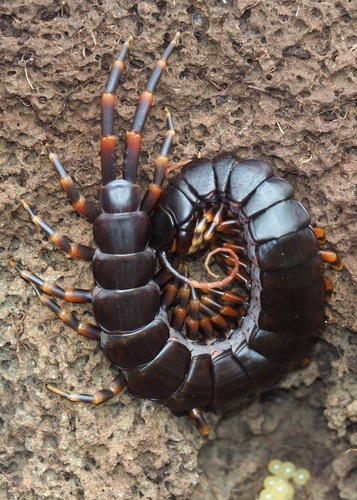
It shows two colour morphs.
Source: Wikipedia
Size
Specimens have been recorded as long as 30 cm.
Source: Wikipedia
Where it lives
It is the only Scolopendra species on the Galápagos Islands, among twelve other centipede species there.
Source: Wikipedia
What it eats
Its diet includes crickets, newborn rodents, the Galápagos rice rat, and a Floreana Racer snake.
Source: Wikipedia
More photos

Questions people ask
What does the Galápagos centipede eat?
It feeds on crickets, newborn rodents, the Galápagos rice rat and even a Floreana Racer snake.
Source: Wikipedia
Are there different colour forms of this centipede?
Yes, it occurs in two colour morphs.
Source: Wikipedia
Same family (Scolopendridae)
 Common Desert CentipedeScolopendra polymorphaCan bite
 Giant Desert CentipedeScolopendra herosCan bite
 Eastern Bark CentipedeHemiscolopendra marginata
 Mediterranean Banded CentipedeScolopendra cingulataCan bite
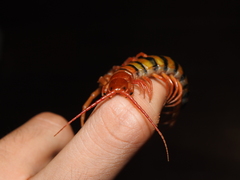 Red-headed CentipedeScolopendra morsitansCan bite
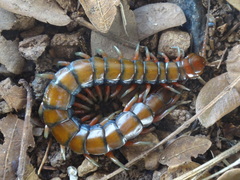 Pacific Giant CentipedeScolopendra subspinipesVenomous
Sources
- Wikipedia: https://en.wikipedia.org/wiki/Scolopendra_galapagoensis
Look it up elsewhere: GBIF · iNaturalist · BugGuide · ITIS · Wikipedia
Text written 2026-10-23 from the sources above and checked sentence by sentence against them. Data fetched 2026-10-23.