 Bug FAQ
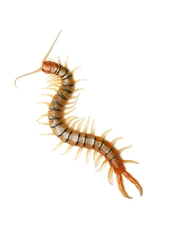
Pacific Giant Centipede
Scolopendra subspinipes · Order: Scolopendromorpha · Family: Scolopendridae
Also called: Bermuda centipede, Centipede, Hawaiian Giant Centipede, Vietnamese Centipede
Source: Wikipedia

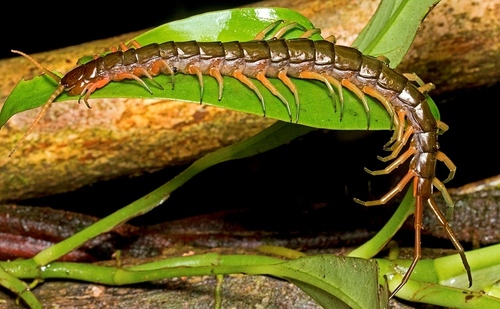
The Pacific giant centipede can grow up to about 20 cm long and is one of the largest centipedes known. It hunts spiders, scorpions and other arachnids, and it can also take small vertebrates such as mice or tiny reptiles. Its venom causes intense pain and a documented fatal bite occurred in the Philippines.
Source: Wikipedia
Size
Adults can reach a maximum length of about 20 cm (7.9 in).
Source: Wikipedia
Does it bite or sting?
Its bite delivers venom that causes extreme pain, and a fatal incident has been recorded.
Source: Wikipedia
Where it lives
It lives in the warm, humid regions of southeastern Asia.
Source: Wikipedia
What it eats
It mainly preys on spiders, scorpions and vinegaroons, and it can also overpower small mice or reptiles.
Source: Wikipedia
Life cycle
A female lays 50-80 eggs and guards them until they hatch; the young molt once a year and reach full size in 3 to 4 years, while adults may live ten years or more.
Source: Wikipedia
Where it comes from
The species is widespread across tropical and subtropical Asia, the Indian Ocean islands, Australia, parts of the Americas, the Caribbean, and possibly the southern United States.
Source: Wikipedia
Where it is found in the US
Recorded in 2 of 51 states and DC. Most records: Hawaii, California.
Darker = more records. Counts are museum and citizen-science records, not population size.
Source: GBIF
Status: introduced in United States. Source: iNaturalist
Months it is reported in the US
Source: GBIF
More photos
Questions people ask
How large does the Pacific giant centipede get?
It can grow up to about 20 cm (7.9 in) in length.
Source: Wikipedia
What does this centipede eat?
It hunts spiders, scorpions, vinegaroons and can also capture small vertebrates like mice or tiny reptiles.
Source: Wikipedia
Can it bite humans?
Yes, its bite injects venom that causes severe pain and has been fatal in at least one documented case.
Source: Wikipedia
Where is the Pacific giant centipede found?
It occurs throughout southeastern Asia and is also common across tropical and subtropical regions of Asia, the Indian Ocean islands, Australia, the Americas, the Caribbean, and possibly the southern United States.
Source: Wikipedia
Same family (Scolopendridae)



Sources
- Wikipedia: https://en.wikipedia.org/wiki/Scolopendra_subspinipes
Look it up elsewhere: GBIF · iNaturalist · BugGuide · ITIS · Wikipedia
Text written 2026-10-23 from the sources above and checked sentence by sentence against them. Data fetched 2026-10-22.