 Bug FAQ
Giant Desert Centipede
Scolopendra heros · Order: Scolopendromorpha · Family: Scolopendridae
Also called: Blue-tailed Centipede, Giant Arizona Desert Centipede, Giant Black-headed Centipede, Giant Black-tailed Centipede
Source: Wikipedia, arthropod.uark.edu

Adults are usually about 6.5 inches long but can grow to 8 inches or more, especially in captivity. They live in deserts, rocky woodlands and other arid to semi-arid areas from the southwestern United States into northern Mexico, reaching as far east as Arkansas and Missouri. At night they hunt insects, other invertebrates and small vertebrates such as rodents, reptiles and amphibians, even grabbing flying insects in the air.
Source: Wikipedia
How to recognize it
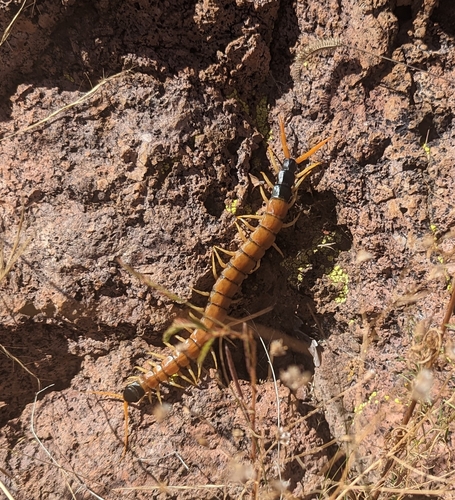
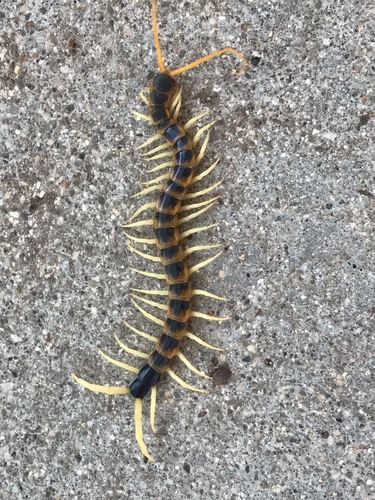
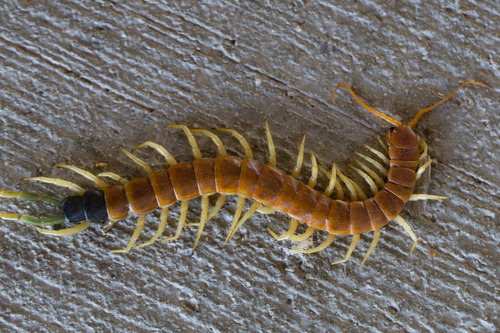
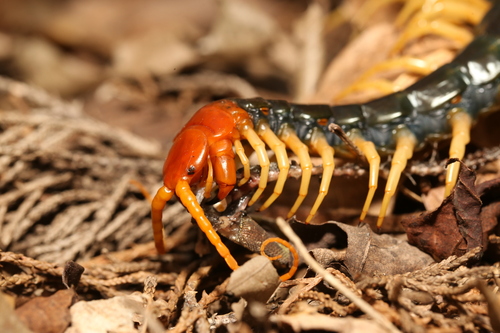
The species shows many color forms; the castaneiceps variant has a red head, chestnut-red first two segments, a black-green trunk, yellow first 20 leg pairs, and black legs with yellow tips on the 21st pair. Its bright aposematic colors warn predators.
Source: Wikipedia, arthropod.uark.edu
Size
Average length is 6.5 inches (170 mm), with a maximum of about 8 inches (200 mm) in the wild.
Source: Wikipedia
Is it a pest in the house?
Often found in rocky woodland near human habitations, but evidence does not describe damage to structures or stored goods.
Source: arthropod.uark.edu
Does it bite or sting?
Bites are very painful to vertebrates. A 1920s experiment showed a bite lasting about four seconds with the fangs left inserted.
Source: Wikipedia, arthropod.uark.edu
How to get rid of it
Females lay eggs in cavities of decayed wood and guard the clutch, winding their bodies around the eggs with legs directed toward them.
Source: arthropod.uark.edu
Where it lives
Found in the Sonoran and Chihuahuan deserts as well as rocky woodland areas in states like Arkansas.
Source: Wikipedia
What it eats
A nocturnal predator of insects, other invertebrates and small vertebrates such as rodents, reptiles and amphibians. Can reach into the air to catch small flying insects.
Source: Wikipedia
Life cycle
Hatch from eggs and grow slowly, living more than ten years.
Source: Wikipedia
Where it comes from
Native to the southwestern United States and northern Mexico.
Source: Wikipedia
Lookalikes
Centipedes have one pair of legs per body segment attached to the sides, unlike millipedes which have two pairs per segment. They belong to the class Chilopoda, which is divided into four orders.
Source: arthropod.uark.edu
Where it is found in the US
Recorded in 16 of 51 states and DC. Most records: Texas, Arizona, Oklahoma, New Mexico, Arkansas, Kansas, Louisiana, Missouri.
Darker = more records. Counts are museum and citizen-science records, not population size.
Source: GBIF
Status: native in North America; native in United States. Source: iNaturalist
Months it is reported in the US
Source: GBIF
More photos
Questions people ask
Do they bite?
Yes, their bite is very painful and causes sharp, searing pain and swelling in humans.
Source: Wikipedia
How large can a giant desert centipede get?
Adults average about 6.5 inches long but can reach up to 8 inches, especially in captivity.
Source: Wikipedia
What do they eat?
They hunt at night, feeding on insects, other invertebrates and small vertebrates like rodents, reptiles and amphibians, and can even snatch flying insects.
Source: Wikipedia
Same family (Scolopendridae)
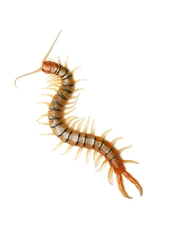 Common Desert CentipedeScolopendra polymorphaCan bite
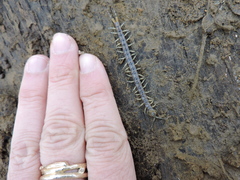 Eastern Bark CentipedeHemiscolopendra marginata
 Mediterranean Banded CentipedeScolopendra cingulataCan bite
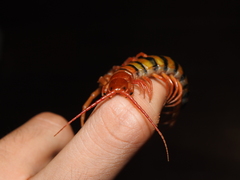 Red-headed CentipedeScolopendra morsitansCan bite
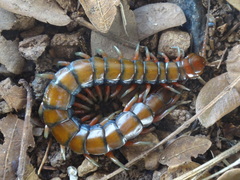 Pacific Giant CentipedeScolopendra subspinipesVenomous
 Vietnamese CentipedeScolopendra dehaani
Sources
- Wikipedia: https://en.wikipedia.org/wiki/Scolopendra_heros
- arthropod.uark.edu: https://arthropod.uark.edu/?p=27347
Look it up elsewhere: GBIF · iNaturalist · BugGuide · ITIS · Wikipedia
Text written 2026-10-23 from the sources above and checked sentence by sentence against them. Data fetched 2026-10-23.