 Bug FAQ
Galápagos carpenter bee
Xylocopa darwini · Order: Hymenoptera · Family: Apidae
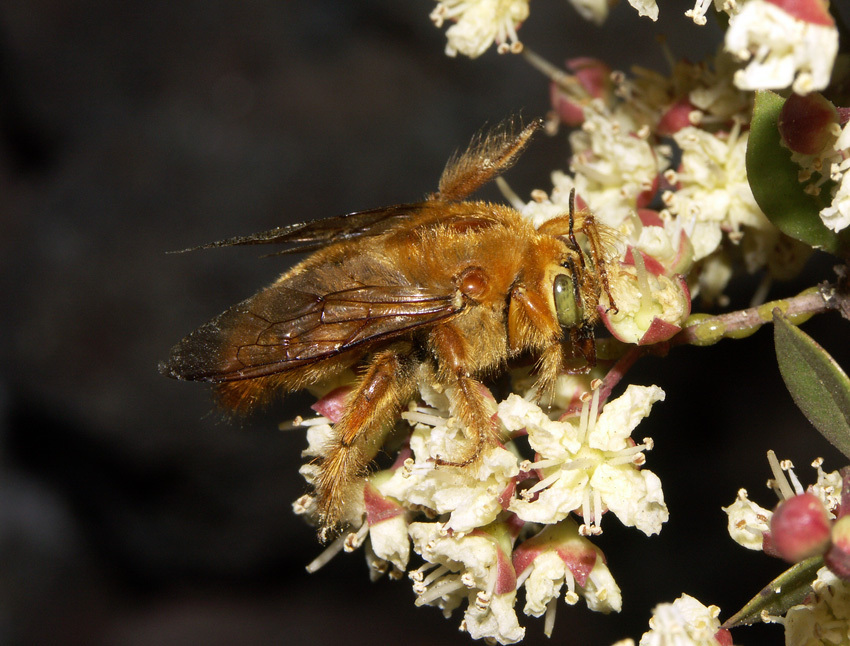
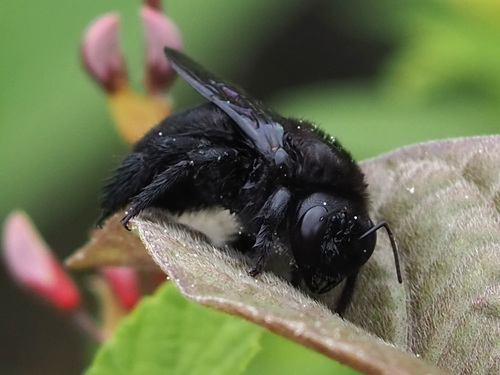
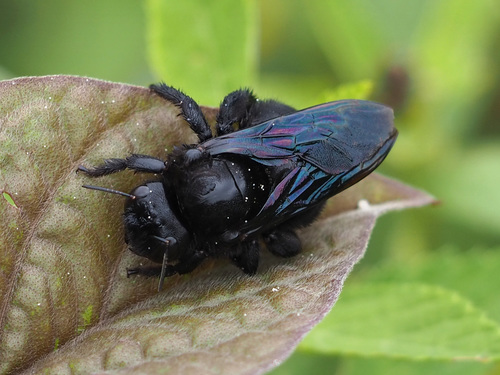
Females are dark and shiny with black hairs, while males are rarer and have a black abdomen with yellow-brown hairs. They bore holes in soft dead wood to lay eggs and pollinate at least 84 flowering plant species.
Source: Wikipedia
How to recognize it
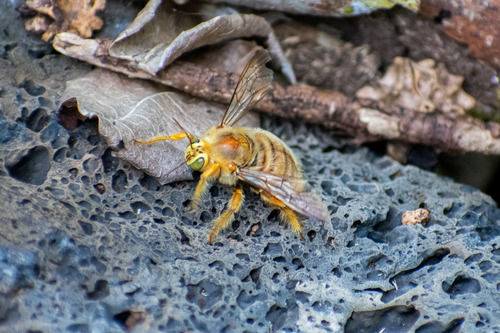
Females are dark and shiny with black setae; males are rarer and have a black abdomen with yellow-brown setae.
Source: Wikipedia
Where it lives
They bore holes into branches and trunks of trees to create solitary cavities for their larvae.
Source: Wikipedia
What it eats
They compete for food with birds, lizards and other insects.
Source: Wikipedia
Life cycle
Males and females look different, showing sexual dimorphism. A rare museum specimen shows gynandromorphism, with one side looking female and the other male.
Source: Wikipedia
When you see it
Females are commonly found throughout the year.
Source: Wikipedia
Where it comes from
Xylocopa darwini is endemic to the Galápagos Islands and is the only native bee there.
Source: Wikipedia
Lookalikes
Introduced leaf-cutter and wool-carder bees are the only similar species; the carpenter bee remains the sole native bee.
Source: Wikipedia
More photos
Questions people ask
How can I tell a male from a female Galápagos carpenter bee?
Females are dark and shiny with black hairs, while males have a black abdomen and yellow-brown hairs.
Source: Wikipedia
What plants does this bee pollinate?
It visits at least 84 different flowering species, making it the most generalized pollinator in the Galápagos.
Source: Wikipedia
Same family (Apidae)


Sources
- Wikipedia: https://en.wikipedia.org/wiki/Xylocopa_darwini
Look it up elsewhere: GBIF · iNaturalist · BugGuide · ITIS · Wikipedia
Text written 2026-10-23 from the sources above and checked sentence by sentence against them. Data fetched 2026-10-23.