 Bug FAQ
French Paper Wasp
Polistes gallicus · Order: Hymenoptera · Family: Eumenidae
Also called: Paper wasp
Source: Wikipedia

These wasps have bright yellow and black markings with orange antennae that are paler underneath and have yellow-marked scapes. They are omnivorous, feeding on fruit, flower nectar, insects, snails and carrion, and they also collect nectar to feed their brood.
Source: Wikipedia
How to recognize it
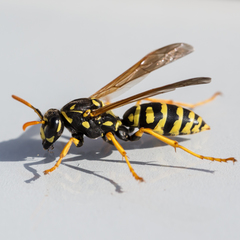
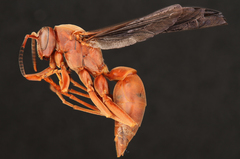
They show bright yellow and black patterns typical of the subgenus Polistes. Their antennae are orange, lighter on the underside, with yellow-marked scapes.
Source: Wikipedia
Size
Females have 12 antennal segments and 6 abdominal segments. Males have 13 antennal segments and 7 abdominal segments.
Source: Wikipedia
Does it bite or sting?
Polistes wasps defend their colonies with stings and venom. Their venom contains four major allergens: antigen 5, hyaluronidase, phospholipase and protease.
Source: Wikipedia
Where it lives
In cooler areas north of the Alps they often nest in protected sites such as pipes or metal scraps.
Source: Wikipedia
What it eats
They eat fruit, flower nectar, insects, snails and carrion. Adults also collect nectar to feed their larvae.
Source: Wikipedia
Life cycle
Females are identified by 12 antennal segments and 6 abdominal segments. Males are identified by 13 antennal segments and 7 abdominal segments.
Source: Wikipedia
Where it comes from
They are common across much of Europe, except England, Denmark, and Scandinavia.
Source: Wikipedia
Where it is found in the US
Recorded in 2 of 51 states and DC. Most records: Iowa, New York.
Darker = more records. Counts are museum and citizen-science records, not population size.
Source: GBIF
More photos

Questions people ask
What do they eat?
They feed on fruit, nectar, insects, snails and carrion, and also collect nectar for their larvae.
Source: Wikipedia
How can I tell a female from a male?
Females have 12 antennal segments and 6 abdominal segments, while males have 13 antennal segments and 7 abdominal segments.
Source: Wikipedia
Same family (Eumenidae)



Sources
- Wikipedia: https://en.wikipedia.org/wiki/Polistes_gallicus
Look it up elsewhere: GBIF · iNaturalist · BugGuide · Wikipedia
Text written 2026-10-23 from the sources above and checked sentence by sentence against them. Data fetched 2026-10-22.