 Bug FAQ
Four-striped Digger Bee
Amegilla quadrifasciata · Order: Hymenoptera · Family: Apidae
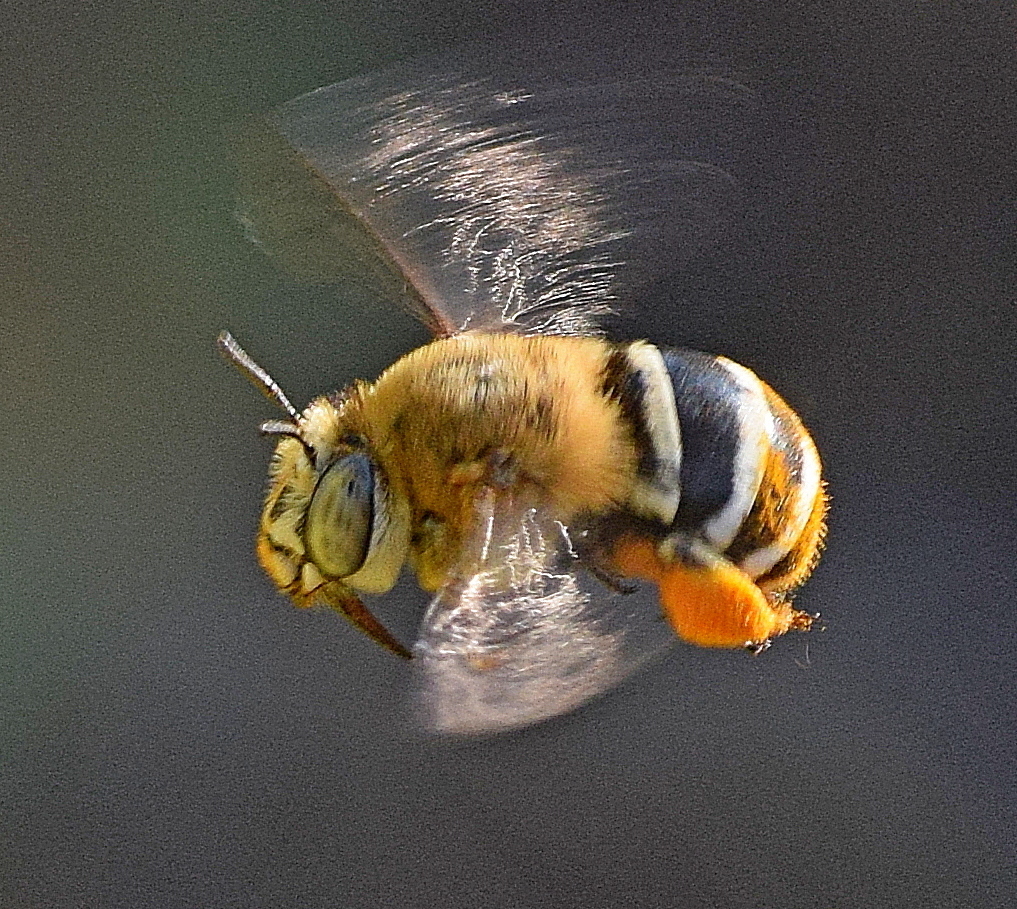
The four-striped digger bee is a small solitary bee about 9 to 12 mm long, with an orange-brown, densely hairy thorax and alternating black and white stripes on the abdomen. Females dig their own nests in loose soil, lay eggs there, and the larvae develop on stored pollen and nectar, pupating in autumn and emerging as adults from March to June. They are found from the Canary Islands to Japan, including most of central and southern Europe, central Asia and North Africa, and feed on flowers of Fabaceae, Lamiaceae, Boraginaceae and Primulaceae.
Source: Wikipedia
Size
Adults measure about 9 to 12 mm in length.
Source: Wikipedia
Where it lives
These are solitary bees; each female builds and tends her own nest in loose soil.
Source: Wikipedia
What it eats
Adults visit flowers of legumes, mints, forget-me-not family and primroses for nectar and pollen from March to June. The larvae are fed pollen and nectar stored in the brood cells.
Source: Wikipedia
Life cycle
Larvae pupate in autumn and emerge as adults in early spring. Each female cares for her own offspring without forming colonies.
Source: Wikipedia
When you see it
Adults are active from March through June.
Source: Wikipedia
Where it comes from
Their range extends from the Canary Islands eastward to Japan, covering most of central and southern Europe, central Asia and North Africa.
Source: Wikipedia
Lookalikes
Males look similar to females.
Source: Wikipedia
More photos

Questions people ask
What plants do they visit?
They feed on flowers of legumes, mints, forget-me-not family and primroses.
Source: Wikipedia
Where are they found?
Their distribution runs from the Canary Islands to Japan, including most of central and southern Europe, central Asia and North Africa.
Source: Wikipedia
Same family (Apidae)





Sources
- Wikipedia: https://en.wikipedia.org/wiki/Amegilla_quadrifasciata
Look it up elsewhere: GBIF · iNaturalist · BugGuide · ITIS · Wikipedia
Text written 2026-10-23 from the sources above and checked sentence by sentence against them. Data fetched 2026-10-22.