 Bug FAQ
Four-spotted antlion
Distoleon tetragrammicus · Order: Neuroptera · Family: Myrmeleontidae
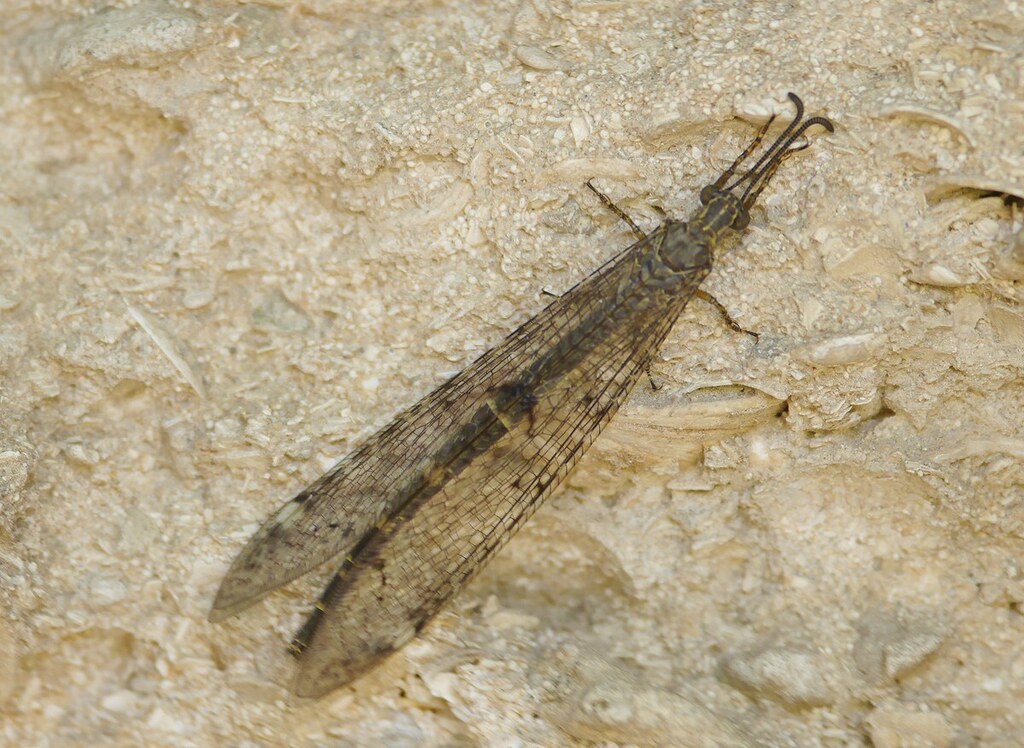
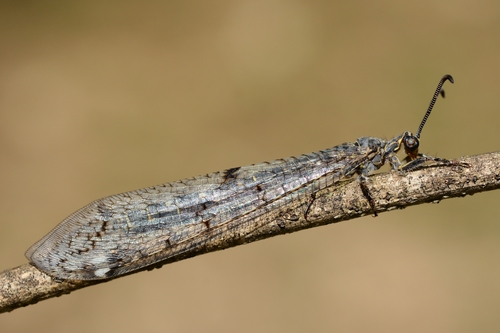
The four-spotted antlion adult looks like a dragonfly with a 75 mm wingspan and dark brown body marked with brown spots. Its larvae are 12 to 22 mm long, live in sand, and hunt small insects with powerful jaws.
Source: Wikipedia
Size
Adults have a wingspan of about 75 mm (3 in). Fully grown larvae measure 12 to 22 mm (0.47 to 0.87 in) in length.
Source: Wikipedia
Where it lives
Found in many habitats from coastal dunes to mountain forests, especially dry, sandy areas, oak and pine woods, and calcareous wastelands with little moisture. Larvae avoid exposed sites such as open dunes.
Source: Wikipedia
What it eats
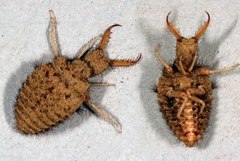
Both adults and larvae are voracious predators that catch small insects and other arthropods with powerful jaws. Larvae look very different from the adult form.
Source: Wikipedia
Life cycle
Females lay eggs in sand; after about a year the larva builds a cocoon and metamorphoses into an adult.
Source: Wikipedia
When you see it
Adults appear in mid-summer and are on the wing from June to August. They are attracted to light.
Source: Wikipedia
Where it comes from
Widespread in the western Palearctic, present throughout most of Southern Europe and North Africa.
Source: Wikipedia
Lookalikes
It can be confused with the antlion Myrmeleon formicarius.
Source: Wikipedia
More photos
Questions people ask
Are they a garden pest?
They prey on small insects and are not reported to damage plants.
Source: Wikipedia
Same family (Myrmeleontidae)




Sources
- Wikipedia: https://en.wikipedia.org/wiki/Distoleon_tetragrammicus
Look it up elsewhere: GBIF · iNaturalist · BugGuide · ITIS · Wikipedia
Text written 2026-10-22 from the sources above and checked sentence by sentence against them. Data fetched 2026-10-22.