 Bug FAQ
Fog-belt Bumble Bee
Bombus caliginosus · Order: Hymenoptera · Family: Apidae
Also called: Obscure Bumble Bee

The obscure bumblebee has longer hairs and yellow hairs on the underside of its abdomen, unlike the similar B. vosnesenskii which has only black hairs there. It lives on the West Coast of the United States, from Washington through Oregon to southern California. Queens emerge in late January, workers appear in early March, males follow by late April, and the colony ends in late October.
Source: Wikipedia
How to recognize it
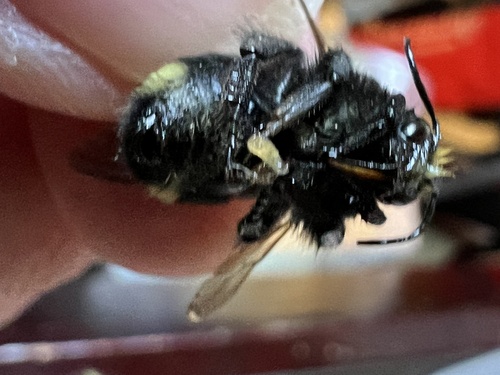
The bee has longer hairs overall and shows yellow hairs on the underside of the abdomen, while the similar B. vosnesenskii has only black hairs there.
Source: Wikipedia
Where it lives
Workers are most often seen on legume plants (Fabaceae), queens on heath family plants (Ericaceae), and males on aster family plants (Asteraceae).
Source: Wikipedia
When you see it
Queens emerge in late January, workers in early March, males by late April, and the colony ends in late October.
Source: Wikipedia
Where it is found in the US
Recorded in 6 of 51 states and DC. Most records: Oregon, California, Washington, Arizona, Illinois, Florida.
Darker = more records. Counts are museum and citizen-science records, not population size.
Source: GBIF
Status: native in North America; native in Canada. Source: iNaturalist
Months it is reported in the US
Source: GBIF
More photos
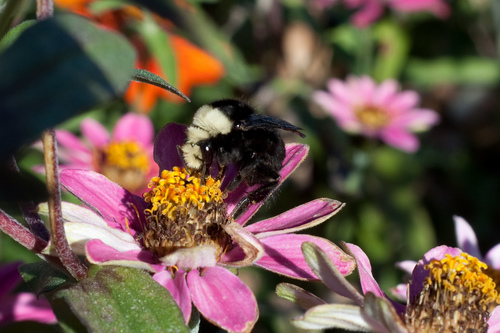
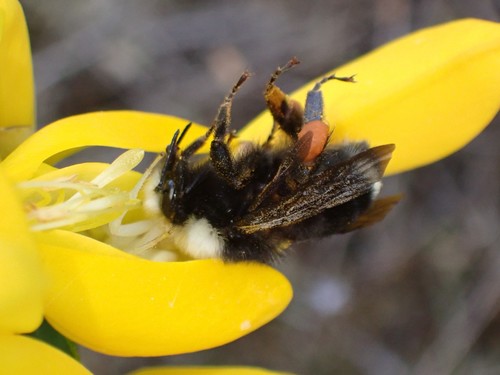
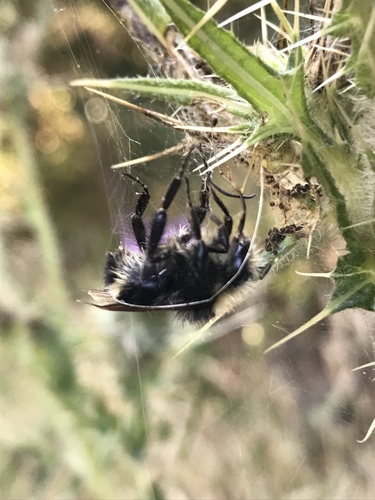
Questions people ask
When are they active during the year?
Queens become active in late January, workers appear in early March, males by late April, and the colony ends in late October.
Source: Wikipedia
Where can I find this bumble bee?
It lives on the West Coast of the United States, from Washington through Oregon to southern California.
Source: Wikipedia
Same family (Apidae)





Sources
- Wikipedia: https://en.wikipedia.org/wiki/Bombus_caliginosus
Look it up elsewhere: GBIF · iNaturalist · BugGuide · ITIS · Wikipedia
Text written 2026-10-23 from the sources above and checked sentence by sentence against them. Data fetched 2026-10-23.