 Bug FAQ
Florida Hypotrichia
Hypotrichia spissipes · Order: Coleoptera · Family: Scarabaeidae
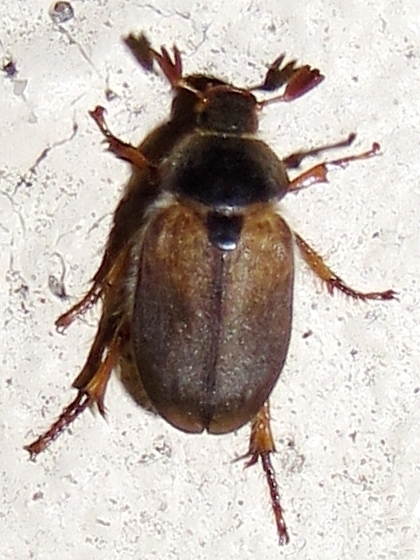
Adults measure roughly 12 to 16 mm in length. Males only take to the air during rain, while females have full wings but are thought to rarely or never fly.
Source: Wikipedia
How to recognize it
They can be told apart from other U.S. Melolonthinae by their uniquely lobed tarsal claws and the absence of scale-like hairs.
Source: Wikipedia
Size
Adults are about 12.4 to 16 mm long.
Source: Wikipedia
Life cycle
Male beetles fly only when it is raining; females have fully developed wings but are believed to seldom or never fly.
Source: Wikipedia
Where it is found in the US
Recorded in 1 of 51 states and DC. Most records: Florida.
Darker = more records. Counts are museum and citizen-science records, not population size.
Source: GBIF
Status: endemic in United States. Source: iNaturalist
Months it is reported in the US
Source: GBIF
More photos
Questions people ask
How large does Florida Hypotrichia get?
Adults grow to about 12.4 to 16 mm in length.
Source: Wikipedia
How can I recognize this beetle?
Look for uniquely lobed tarsal claws and no scale-like hairs; these features separate it from all other U.S. Melolonthinae.
Source: Wikipedia
Do females fly?
Females have fully developed wings but are thought to rarely or never fly.
Source: Wikipedia
Same family (Scarabaeidae)
 Japanese BeetlePopillia japonicaDamages trees, gardens or crops
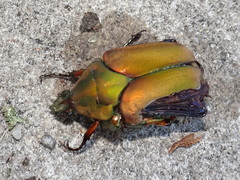 Common Green June BeetleCotinis nitidaDamages trees, gardens or crops
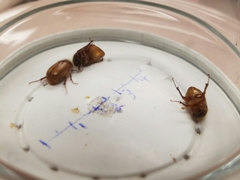 Phyllophaga crinitaDamages trees, gardens or crops
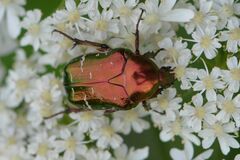 European Rose ChaferCetonia aurata
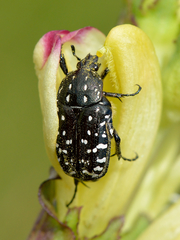 Mediterranean Spotted ChaferOxythyrea funestaDamages trees, gardens or crops
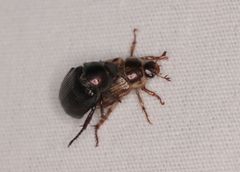 Oriental BeetleExomala orientalisDamages trees, gardens or crops
Sources
- Wikipedia: https://en.wikipedia.org/wiki/Hypotrichia_%28beetle%29
Look it up elsewhere: GBIF · iNaturalist · BugGuide · ITIS · Wikipedia
Text written 2026-10-27 from the sources above and checked sentence by sentence against them. Data fetched 2026-10-27.