 Bug FAQ
Florida Bee-Killer
Mallophora bomboides · Order: Diptera · Family: Asilidae
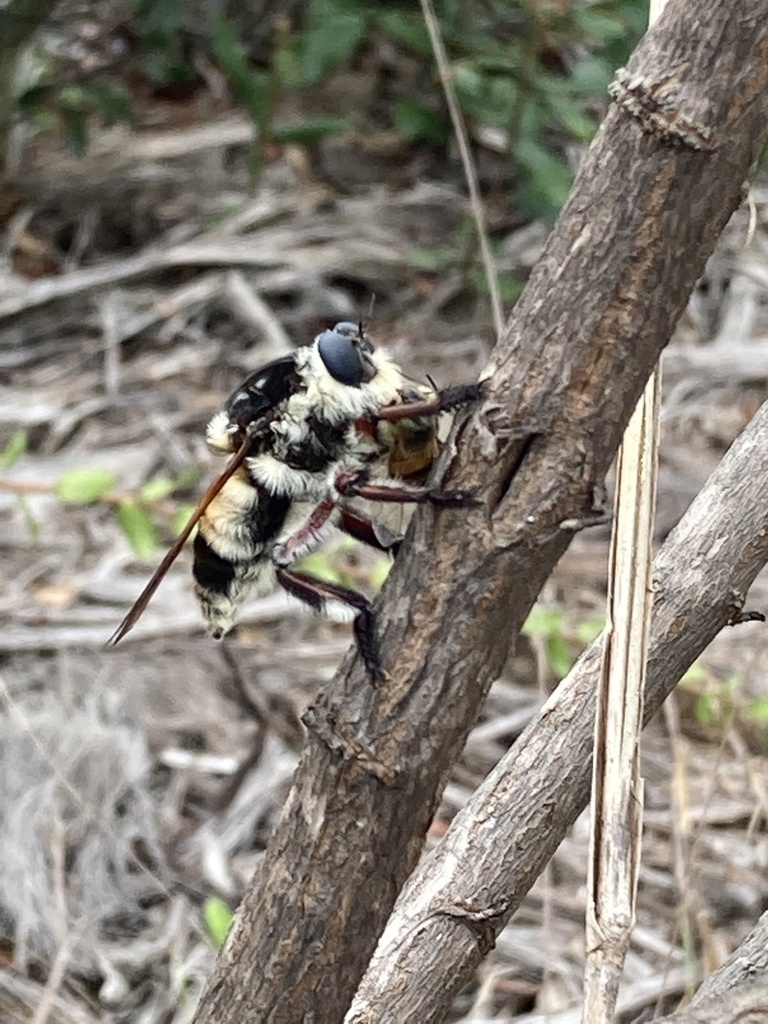
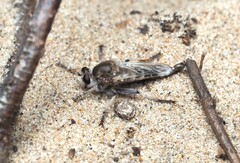
The Florida bee-killer is about 25 mm long and has a distinctive pattern of yellow and black hairs on its abdomen (size, id_marks). Adults live in open areas near apiaries, perching on weeds or shrub tips to launch attacks on bumblebees (habitat, diet). They are found in the southeastern United States, especially Florida, from April through December, with a peak in late summer (native_range, season).
Source: Wikipedia
How to recognize it
Three basal abdominal segments are densely covered with yellow hairs, the next two have black hairs, and the last two have pale hairs; the underside of the abdomen also has yellow hairs.
Source: Wikipedia
Size
The average body length is about 25 mm.
Source: Wikipedia
Where it lives
Adults live in open habitats near apiaries, perching on weed stalks or shrub tips.
Source: Wikipedia
What it eats
It preys on aculeate Hymenoptera, especially bumblebees such as Bombus pensylvanicus, which it closely resembles.
Source: Wikipedia
Life cycle
Females lay their eggs in soil. Adults perch on plants and launch attacks on bumblebee prey.
Source: Wikipedia
When you see it
In Florida they fly from April through December, most commonly seen in late summer.
Source: Wikipedia
Lookalikes
It is a classic example of Batesian mimicry, looking very similar to the bumblebees it hunts.
Source: Wikipedia
Where it is found in the US
Recorded in 5 of 51 states and DC. Most records: Florida, North Carolina, Georgia, Alabama, South Carolina.
Darker = more records. Counts are museum and citizen-science records, not population size.
Source: GBIF
Months it is reported in the US
Source: GBIF
More photos

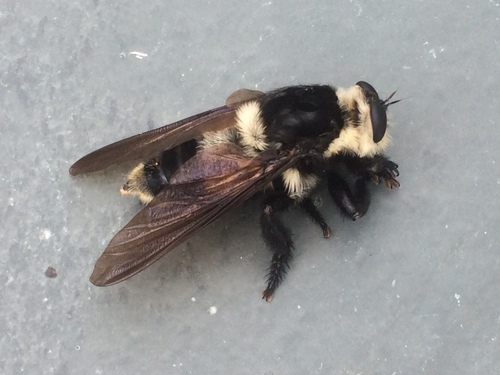
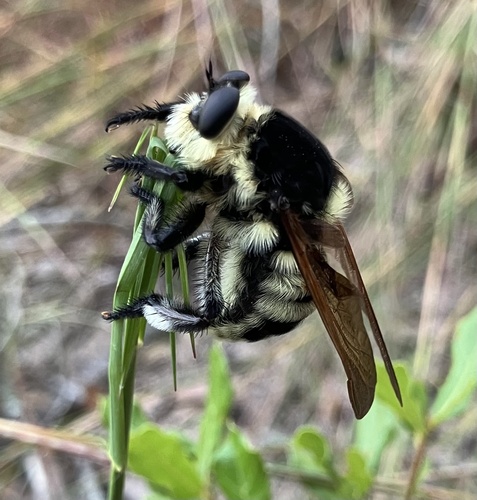
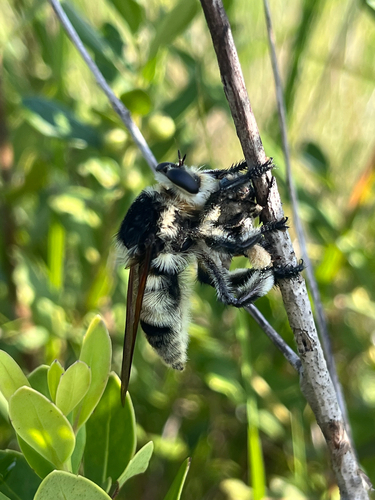
Questions people ask
What does the Florida bee-killer look like?
It has three front abdominal segments covered in yellow hairs, the next two with black hairs, and the last two with pale hairs; the belly side also shows yellow hairs.
Source: Wikipedia
When are they active?
In Florida they are active from April to December, with the highest numbers in late summer.
Source: Wikipedia
Where can I find them?
They live in open areas near apiaries across the southeastern United States, especially in states like Florida, Georgia, and the Carolinas.
Source: Wikipedia
What do they eat?
They hunt and eat various stinging Hymenoptera, particularly bumblebees such as Bombus pensylvanicus.
Source: Wikipedia
Same family (Asilidae)

Sources
- Wikipedia: https://en.wikipedia.org/wiki/Mallophora_bomboides
Look it up elsewhere: GBIF · iNaturalist · BugGuide · ITIS · Wikipedia
Text written 2026-10-25 from the sources above and checked sentence by sentence against them. Data fetched 2026-10-25.