 Bug FAQ
Northeastern Hammertail
Efferia aestuans · Order: Diptera · Family: Asilidae
Source: Wikipedia
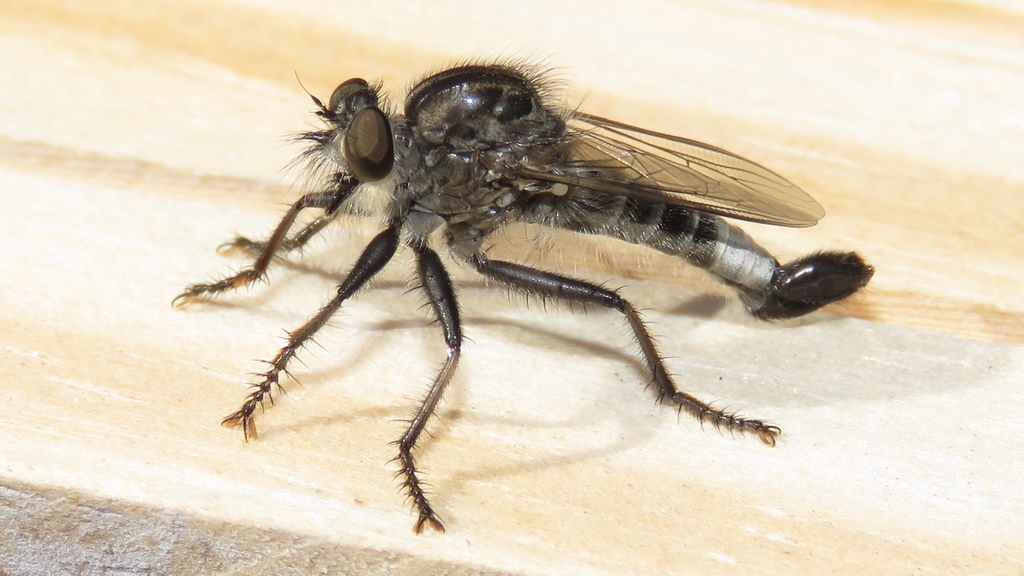
Northeastern Hammertails are medium-sized flies about 18 to 22 mm long with a wingspan of 30 to 50 mm. Adults are active from May through September and are found in wetlands, grasslands, dry sandy spots and near human settlements across eastern North America.
Source: Wikipedia
How to recognize it
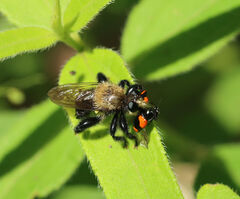
Their wings are long, slim, transparent with brown veins and have a smoky amber tint.
Source: Wikipedia
Size
Body length ranges from about 14 mm to 28 mm, most commonly 18 to 22 mm. Wingspan ranges from roughly 30 mm to 50 mm.
Source: Wikipedia
Does it bite or sting?
They do not bite or sting unless directly threatened, and even then any bite is mild.
Source: Wikipedia
Where it lives
Adults live in wetlands, grasslands, dry sandy areas and around human construction sites.
Source: Wikipedia
What it eats
They hunt and eat insects including flies, bees, butterflies, moths, grasshoppers and dragonflies.
Source: Wikipedia
Life cycle
Juveniles are wingless and live underground, feeding on grubs in sand dunes.
Source: Wikipedia
Where it comes from
They are native to eastern North America, from Ontario and New Hampshire south to Florida and New Mexico.
Source: Wikipedia
Lookalikes
They sometimes mimic bees or wasps to deter predators, even though they lack stingers.
Source: Wikipedia
Where it is found in the US
Recorded in 39 of 51 states and DC. Most records: Massachusetts, New York, Ohio, Michigan, New Hampshire, Connecticut, Illinois, Maine.
Darker = more records. Counts are museum and citizen-science records, not population size.
Source: GBIF
Status: native in North America. Source: iNaturalist
Months it is reported in the US
Source: GBIF
More photos


Questions people ask
Do they bite?
They will not bite unless they feel directly threatened, and any bite is mild.
Source: Wikipedia
Where can I find them?
They live in wetlands, grasslands, dry sandy areas and near human settlements across eastern North America.
Source: Wikipedia
Same family (Asilidae)
Sources
- Wikipedia: https://en.wikipedia.org/wiki/Efferia_aestuans
Look it up elsewhere: GBIF · iNaturalist · BugGuide · ITIS · Wikipedia
Text written 2026-10-22 from the sources above and checked sentence by sentence against them. Data fetched 2026-10-22.