 Bug FAQ
Stripe-legged Robber Fly
Dioctria hyalipennis · Order: Diptera · Family: Asilidae
Also called: Glassy-winged Robber Fly, European Longhorn Robber, Stripe-legged Robberfly
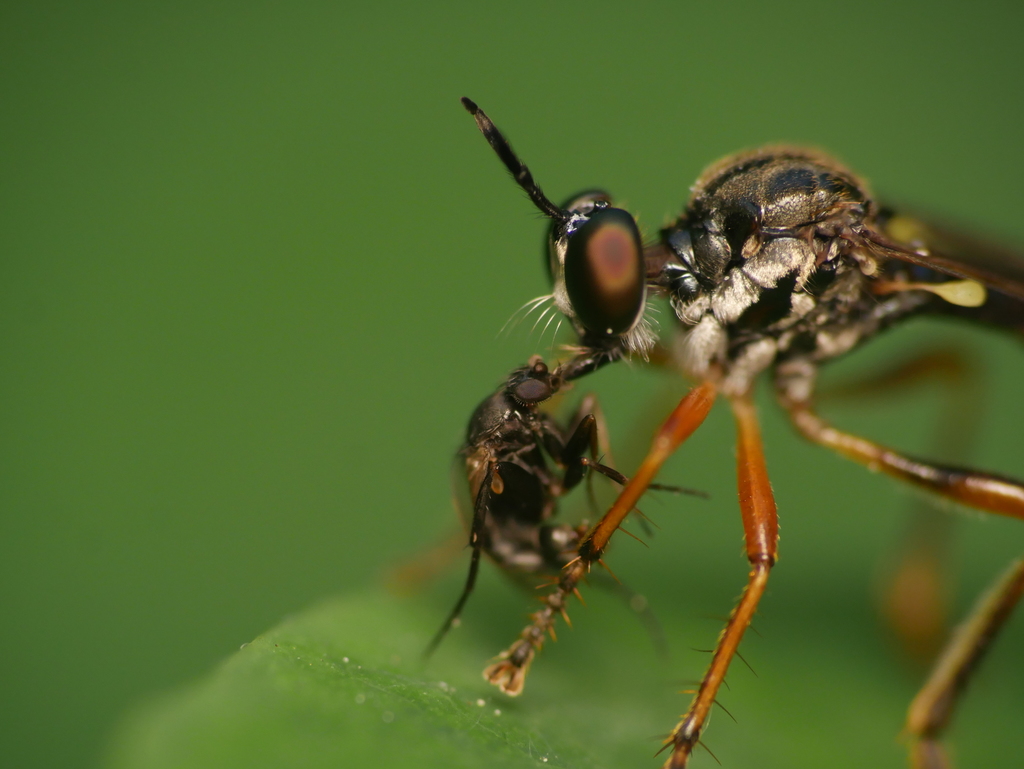
The stripe-legged robber fly has a shiny black head, a silvery-white face, and a white mystax with a short black proboscis. Adults hunt small wasps, bees, other flies and tiny grasshoppers, and they are active from May to July in meadows, hedgerows, forest edges and near spruce or cedar trees.
Source: Wikipedia
How to recognize it
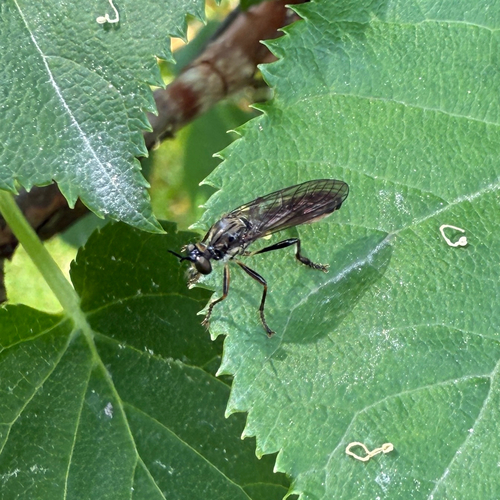
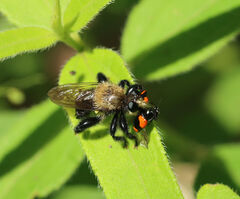
The upper head and vertex are glossy black. The lower face is covered with silvery-white hairs. It has a white mystax and a short black proboscis. Antennae are Y-shaped with segments of equal length. The thorax is raised, appearing humped. Front and middle legs are mainly yellow with black dorsal streaks and dark tips. Hind legs are black and the first foot segment is swollen. The abdomen shines black.
Source: Wikipedia
What it eats
Adults mainly prey on small wasps and bees such as Lasioglossum and Hylaeus. They also eat small flies and tiny grasshoppers (Tetrigidae).
Source: Wikipedia
Life cycle
Adults are on the wing from May through July.
Source: Wikipedia
When you see it
Active during May to July.
Source: Wikipedia
Where it comes from
It is a Holarctic species.
Source: Wikipedia
Lookalikes
It can be hard to tell apart from other Dioctria species. The male of Eudioctria albius has all dark legs, unlike this species.
Source: Wikipedia
Where it is found in the US
Recorded in 22 of 51 states and DC. Most records: Massachusetts, New York, Michigan, Vermont, Maine, Ohio, Wisconsin, New Hampshire.
Darker = more records. Counts are museum and citizen-science records, not population size.
Source: GBIF
Status: introduced in Canada; introduced in United States. Source: iNaturalist
Months it is reported in the US
Source: GBIF
More photos

Questions people ask
What do these flies eat?
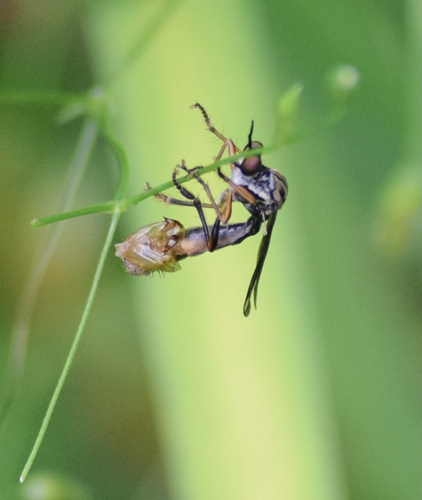
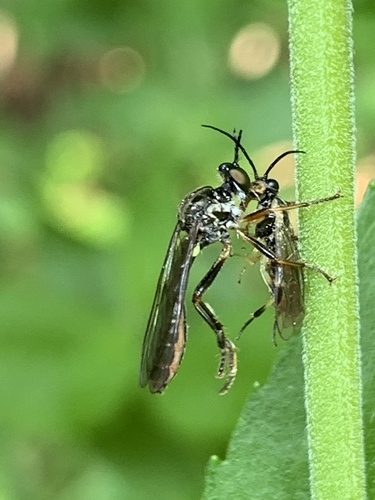
They hunt small wasps, bees, other flies and tiny grasshoppers.
Source: Wikipedia
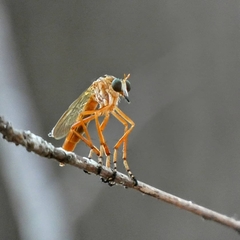
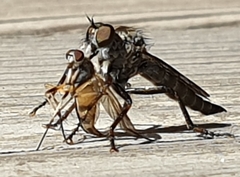
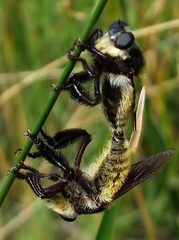
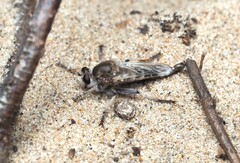
Same family (Asilidae)

Sources
- Wikipedia: https://en.wikipedia.org/wiki/Dioctria_hyalipennis
Look it up elsewhere: GBIF · iNaturalist · BugGuide · Wikipedia
Text written 2026-10-22 from the sources above and checked sentence by sentence against them. Data fetched 2026-10-22.