 Bug FAQ
Fiery Searcher
Calosoma scrutator · Order: Coleoptera · Family: Carabidae
Also called: Caterpillar Hunter, Fiery Searcher Beetle

The Fiery Searcher is a large, colorful ground beetle found mainly in eastern North America. Adults hunt at night in spring, eating caterpillars and other worms, and they release a foul-smelling oil when handled. Its life cycle includes egg, larva, pupa and adult stages, with larvae pupating in soil after about a week.
Source: Wikipedia
How to recognize it
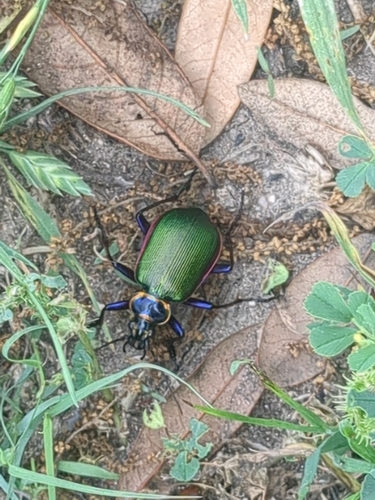
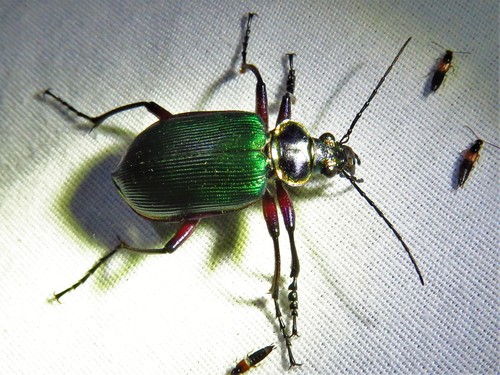
It has a bright green abdomen edged with a reddish-gold line, a bluish-black thorax, and black head and legs.
Source: Wikipedia
Size
Adults can grow up to 35 mm (1.4 in) long, making them among the biggest ground beetles in North America.
Source: Wikipedia
Does it bite or sting?
When handled, the adult releases a foul-smelling oil that smells like rotten milk or rancid olive oil.
Source: Wikipedia
Where it lives
They are nocturnal hunters that prefer open fields and gardens but also appear in forests and urban areas.
Source: Wikipedia
What it eats
Adults prey on caterpillars such as the forest tent caterpillar and on cankerworms; larvae are also predatory.
Source: Wikipedia
Life cycle
The beetle passes through egg, larva, pupa and adult stages; after a larval period of about a week it burrows into soil to pupate.
Source: Wikipedia
When you see it
They are most active in spring nights and hide in leaf litter or under bark during winter.
Source: Wikipedia
Where it comes from
First described from Virginia in 1775, they are common along the eastern U.S. coast and have been recorded in Mexico, Venezuela, and Guatemala.
Source: Wikipedia
Where it is found in the US
Recorded in 43 of 51 states and DC. Most records: Texas, Florida, Oklahoma, Arizona, Arkansas, Louisiana, Virginia, Tennessee.
Darker = more records. Counts are museum and citizen-science records, not population size.
Source: GBIF
Status: native in North America; native in Canada; native in United States. Source: iNaturalist
Months it is reported in the US
Source: GBIF
More photos


Questions people ask
Are they a problem for gardens?
They actually help gardens by eating pest caterpillars such as the forest tent caterpillar.
Source: Wikipedia
What do they look like?
They are up to 35 mm long, with a bright green abdomen edged in reddish-gold, a bluish-black thorax, and black head and legs.
Source: Wikipedia
Where might I find them?
They are common in open fields and gardens across the eastern United States and have also been reported in parts of Mexico, Venezuela, and Guatemala.
Source: Wikipedia
Same family (Carabidae)


Sources
- Wikipedia: https://en.wikipedia.org/wiki/Calosoma_scrutator
Look it up elsewhere: GBIF · iNaturalist · BugGuide · ITIS · Wikipedia
Text written 2026-10-22 from the sources above and checked sentence by sentence against them. Data fetched 2026-10-22.