 Bug FAQ
European Shothole Borer
Xyleborus dispar · Order: Coleoptera · Family: Curculionidae
Source: Wikipedia
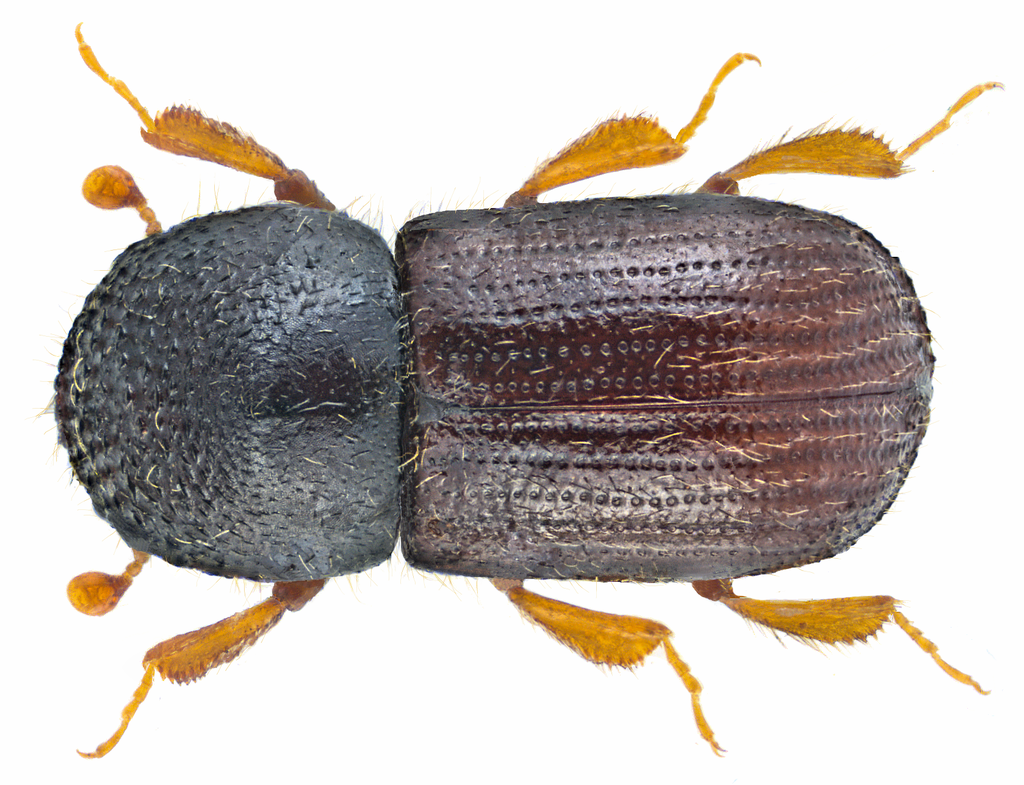
The European Shothole Borer is an invasive beetle that attacks weakened trees and can be a serious pest in orchards and forests. Females are about twice as long as they are wide, measuring 3.2 to 3.7 mm, while males are smaller at 1.8 to 2.1 mm.
Source: Wikipedia
How to recognize it
Its body is stout, black-brown and cylindrical, with dark elytra marked by longitudinal streaks.
Source: Wikipedia
Size
Females measure 3.2 to 3.7 mm in length and are elongated and cylindrical, whereas males are 1.8 to 2.1 mm long. The beetle’s body is about twice as long as it is wide.
Source: Wikipedia
Is it a pest in the house?
It is an economic pest of fruit trees such as apple, pear, apricot and peach, and also damages vineyards. It is a serious pest of chestnut trees.
Source: Wikipedia
How to get rid of it
Synthetic aggregation pheromones may also help control ambrosia beetles like this species.
Source: Wikipedia
Where it lives
The beetle usually attacks trees that are already weakened or compromised.
Source: Wikipedia
What it eats
The species is strongly polyphagous, infesting many types of trees across a wide host range. Its association with fungi may help it overcome tree defenses.
Source: Wikipedia
Life cycle
One generation is produced each year. Adults overwinter in the holes they create, entering true hibernation.
Source: Wikipedia
When you see it
Beetles can be found through June, with peak activity in March and early April. In early spring, females leave their galleries and disperse to find new hosts.
Source: Wikipedia
Where it comes from
It was introduced to North America before 1817.
Source: Wikipedia
Where it is found in the US
Recorded in 10 of 51 states and DC. Most records: Oregon, Michigan, Pennsylvania, Vermont, Maryland, South Carolina, Idaho, Kentucky.
Darker = more records. Counts are museum and citizen-science records, not population size.
Source: GBIF
Status: introduced in Canada. Source: iNaturalist
Months it is reported in the US
Source: GBIF
More photos
Questions people ask
How can I control European Shothole Borer infestations?
Use ethanol-baited sticky or flight traps, and consider synthetic aggregation pheromones to reduce beetle numbers.
Source: Wikipedia
When are European Shothole Borers most active?
Their activity peaks in March and early April, and they can still be found through June.
Source: Wikipedia
What trees does this beetle damage?
It attacks fruit trees like apple, pear, apricot and peach, chestnut trees, and can also harm vineyards.
Source: Wikipedia
Same family (Curculionidae)
 Green Immigrant Leaf WeevilPolydrusus formosusDamages trees, gardens or crops
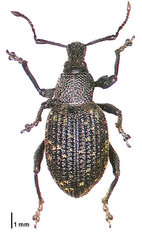 Black Vine WeevilOtiorhynchus sulcatusDamages trees, gardens or crops
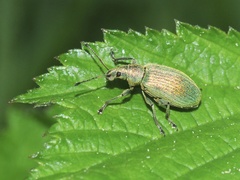 Nettle weevilPhyllobius pomaceusDamages trees, gardens or crops
 Asian Oak WeevilCyrtepistomus castaneusDamages trees, gardens or crops
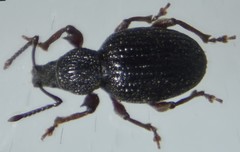 Strawberry Root WeevilOtiorhynchus ovatusDamages trees, gardens or crops
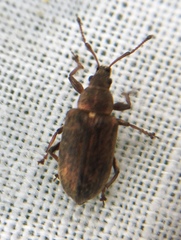 Common Leaf WeevilPhyllobius pyriDamages trees, gardens or crops
Sources
- Wikipedia: https://en.wikipedia.org/wiki/Xyleborus_dispar
Look it up elsewhere: GBIF · iNaturalist · BugGuide · ITIS · Wikipedia
Text written 2026-10-28 from the sources above and checked sentence by sentence against them. Data fetched 2026-10-28.