 Bug FAQ
Epistrophus White Morpho
Morpho epistrophus · Order: Lepidoptera · Family: Nymphalidae
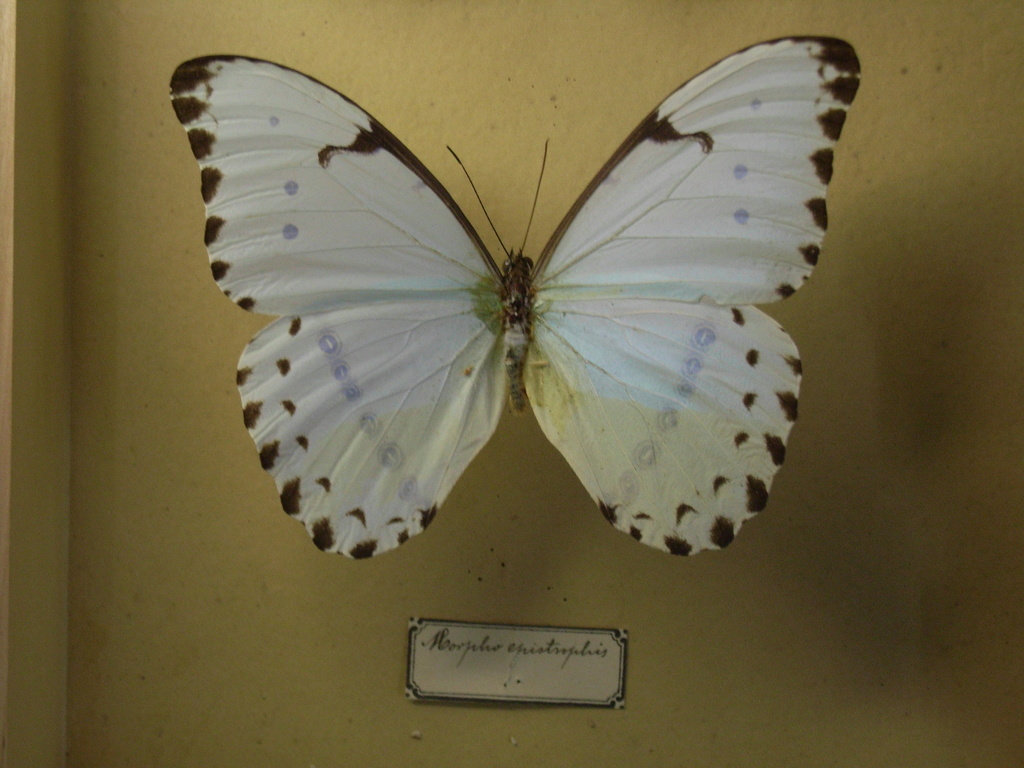
The white morpho (Morpho epistrophus) is a Neotropical butterfly with a chalky, milky or silvery white ground colour. It is found in Brazil, Uruguay, Paraguay and Argentina, especially in the Atlantic Forest. The larvae live on various forest trees.
Source: Wikipedia
How to recognize it
The underside of the hindwing has a chain of narrow, oblong spots with faint white centres and washed-out yellow borders. The upper wing surface mirrors the underside, with the forewing edged in black up to the middle of the wing.
Source: Wikipedia
Where it lives
Larvae develop on a variety of forest trees.
Source: Wikipedia
What it eats
Caterpillars feed on leaves of forest trees.
Source: Wikipedia
Life cycle
The immature stages live on forest trees.
Source: Wikipedia
Where it comes from
It occurs in Brazil, Uruguay, Paraguay and Argentina, mainly in the Atlantic Forest region.
Source: Wikipedia
Lookalikes
It is the best known species of a small group distinguished by its white ground colour.
Source: Wikipedia
Where it is found in the US
Recorded in 1 of 51 states and DC. Most records: New Mexico.
Darker = more records. Counts are museum and citizen-science records, not population size.
Source: GBIF
More photos
Questions people ask
What does the white morpho look like?
It has a chalky, milky or silvery white colour with black-margined forewings and a chain of faintly spotted hindwings.
Source: Wikipedia
Where is the white morpho found?
In Brazil, Uruguay, Paraguay and Argentina, especially within the Atlantic Forest.
Source: Wikipedia
Same family (Nymphalidae)





Sources
- Wikipedia: https://en.wikipedia.org/wiki/Morpho_laertes
Look it up elsewhere: GBIF · iNaturalist · BugGuide · Wikipedia
Text written 2026-10-23 from the sources above and checked sentence by sentence against them. Data fetched 2026-10-22.