 Bug FAQ
Elephant Weevil
Orthorhinus cylindrirostris · Order: Coleoptera · Family: Curculionidae
Source: Wikipedia

Adult elephant weevils range from about 10 to 20 mm in length and show a wide range of colours. Both sides of the pronotum have a tubercle, each elytron bears two tubercles in the second interstices, and a similar tubercle appears on the fifth interstice of the posterior declivity.
Source: Wikipedia
How to recognize it
A tubercle is present on each side of the pronotum, each elytron has two tubercles in the second interstices, and the fifth interstice on the posterior declivity also has a tubercle.
Source: Wikipedia
Size
Adults vary in colour and measure between 10 mm and 20 mm long.
Source: Wikipedia
What it eats
Both adults and larvae feed on a range of eucalyptus species.
Source: Wikipedia
Life cycle
The weevil and its larvae feed on eucalyptus throughout their development.
Source: Wikipedia
Where it comes from
Orthorhinus cylindrirostris belongs to the weevil family Curculionidae.
Source: Wikipedia
Lookalikes
Orthorhinus cylindrirostris is a member of the Curculionidae family.
Source: Wikipedia
More photos

Questions people ask
What plants does the elephant weevil damage?
It feeds on eucalyptus species and is reported as a major pest to vineyards in Australia.
Source: Wikipedia
How big does an adult elephant weevil get?
Adults range from about 10 mm to 20 mm in length.
Source: Wikipedia
How can I recognize an elephant weevil?
Look for tubercles on both sides of the pronotum, two tubercles on each elytron’s second interstice, and a similar tubercle on the fifth interstice of the posterior declivity.
Source: Wikipedia
Same family (Curculionidae)
 Green Immigrant Leaf WeevilPolydrusus formosusDamages trees, gardens or crops
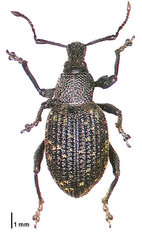 Black Vine WeevilOtiorhynchus sulcatusDamages trees, gardens or crops
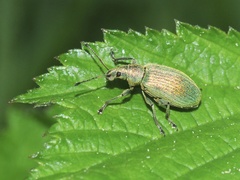 Nettle weevilPhyllobius pomaceusDamages trees, gardens or crops
 Asian Oak WeevilCyrtepistomus castaneusDamages trees, gardens or crops
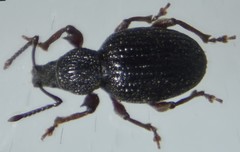 Strawberry Root WeevilOtiorhynchus ovatusDamages trees, gardens or crops
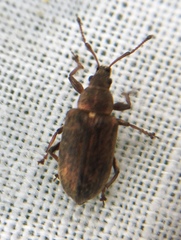 Common Leaf WeevilPhyllobius pyriDamages trees, gardens or crops
Sources
- Wikipedia: https://en.wikipedia.org/wiki/Orthorhinus_cylindrirostris
Look it up elsewhere: GBIF · iNaturalist · BugGuide · Wikipedia
Text written 2026-10-23 from the sources above and checked sentence by sentence against them. Data fetched 2026-10-22.