 Bug FAQ
Eastern Eyed Click Beetle
Alaus oculatus · Order: Coleoptera · Family: Elateridae
Also called: eyed click beetle, Eastern Eyed Elater, Eyed elater

The Eastern Eyed Click Beetle is a black beetle 25 to 45 mm long with distinctive white-framed dark patches on each side of the pronotum. It lives in deciduous and mixed forests across Central and North America, where adults emerge in spring and are seen through September. Adults feed lightly on nectar and plant juices, while larvae eat the grubs of wood-boring beetles and develop in dead wood or soil.
Source: Wikipedia
How to recognize it
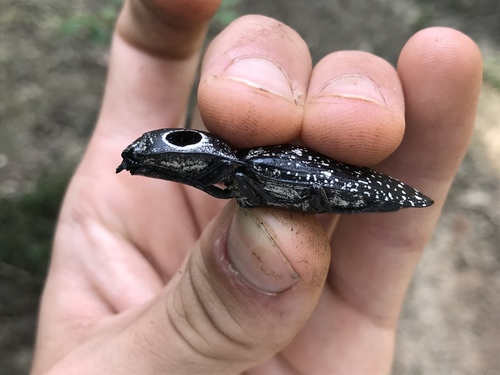
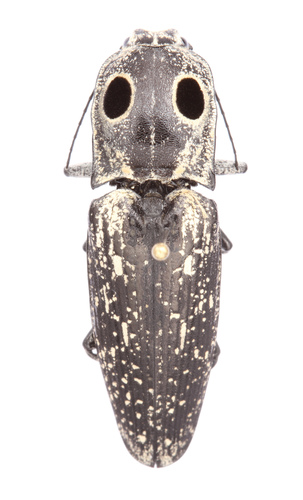
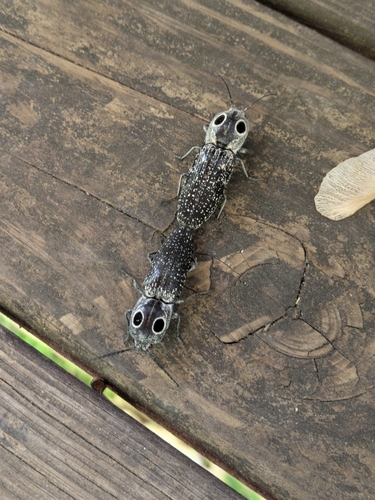
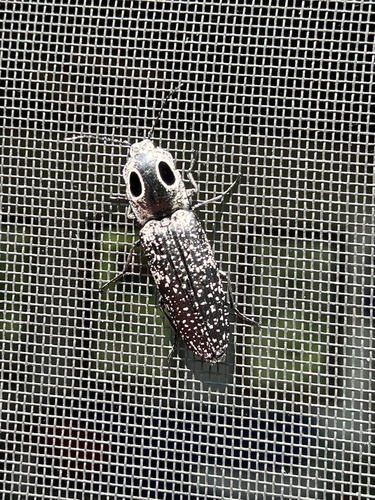
The beetle’s pronotum has a large oval dark patch on each side, each outlined in white, giving the species its common name.
Source: Wikipedia
Size
Adults measure about 25 to 45 mm (1.0 to 1.8 in) in length.
Source: Wikipedia
Where it lives
It inhabits deciduous or mixed forests and woodlands.
Source: Wikipedia
What it eats
Adults sip nectar and plant juices, while larvae prey on wood-boring beetle grubs.
Source: Wikipedia
Life cycle
Females lay eggs in soil or on dead wood; larvae pupate in rotting logs or underground and emerge as adults in spring.
Source: Wikipedia
When you see it
Adults are active from spring until September.
Source: Wikipedia
Where it comes from
The species occurs in Central and North America.
Source: Wikipedia
Where it is found in the US
Recorded in 45 of 51 states and DC. Most records: North Carolina, Virginia, Maryland, Florida, Georgia, New York, Pennsylvania, South Carolina.
Darker = more records. Counts are museum and citizen-science records, not population size.
Source: GBIF
Status: native in North America; native in United States; native in Canada. Source: iNaturalist
Months it is reported in the US
Source: GBIF
More photos
Same family (Elateridae)


Sources
- Wikipedia: https://en.wikipedia.org/wiki/Alaus_oculatus
Look it up elsewhere: GBIF · iNaturalist · BugGuide · ITIS · Wikipedia
Text written 2026-10-22 from the sources above and checked sentence by sentence against them. Data fetched 2026-10-22.