 Bug FAQ
Common brown click beetle
Athous haemorrhoidalis · Order: Coleoptera · Family: Elateridae
Also called: Red-brown Click Beetle
Source: Wikipedia
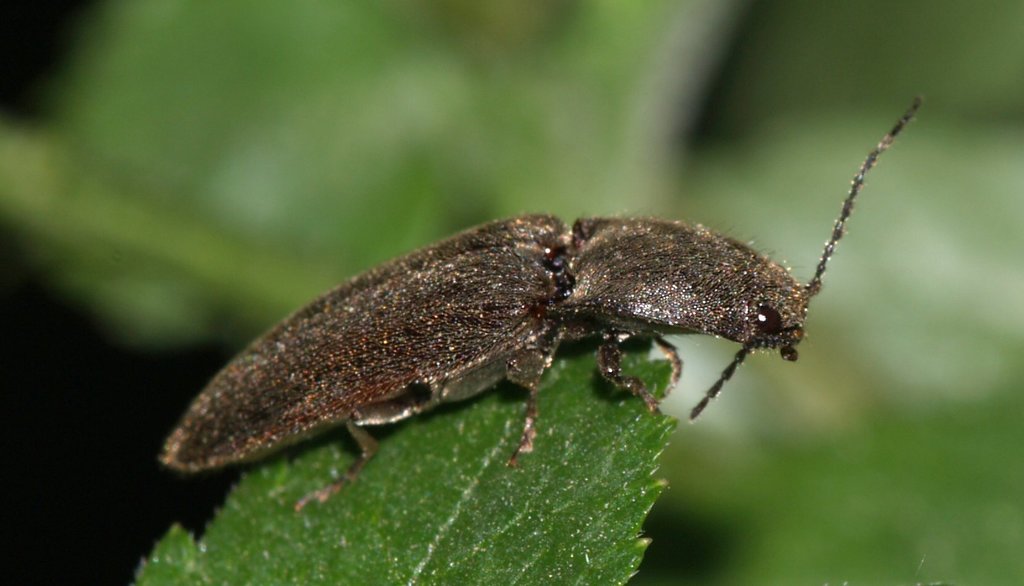
Adult beetles are 10 to 15 mm long, black-headed with brown, ribbed elytra and a dimpled pronotum covered in grey-brown hairs. They live in forests, wetlands and other moist habitats across the British Isles, Europe and Asia, and are most active in July.
Source: Wikipedia
How to recognize it
The head and thorax are black, the wing covers are brown and strongly ribbed, and the whole body has greyish-brown hairs.
Source: Wikipedia
Size
Adults measure about 10 to 15 mm in length.
Source: Wikipedia
Where it lives
They are found mainly in broad-leaved and coniferous forests, as well as wetland habitats like fens and peatlands.
Source: Wikipedia
What it eats
Adults feed on flower pollen, while larvae eat grass roots and also prey on winter moth larvae.
Source: Wikipedia
Life cycle
Fossils show the species has been present in Britain since the early Holocene, after the last ice age. Larvae are known to be damaging agricultural pests.
Source: Wikipedia
When you see it
In Europe they are most active during July.
Source: Wikipedia
Where it comes from
The species occurs throughout the British Isles and is widespread across Europe and Asia.
Source: Wikipedia
Lookalikes
Like other click beetles, they have a flexible hinge between the thorax and abdomen. Males are smaller than females and have a less wavy pronotum side.
Source: Wikipedia
Where it is found in the US
Recorded in 2 of 51 states and DC. Most records: Massachusetts, Washington.
Darker = more records. Counts are museum and citizen-science records, not population size.
Source: GBIF
Status: introduced in Canada. Source: iNaturalist
Questions people ask
Are they a problem for gardens?
The larvae can damage garden grasses by feeding on their roots.
Source: Wikipedia
Same family (Elateridae)


Sources
- Wikipedia: https://en.wikipedia.org/wiki/Athous_haemorrhoidalis
Look it up elsewhere: GBIF · iNaturalist · BugGuide · Wikipedia
Text written 2026-10-22 from the sources above and checked sentence by sentence against them. Data fetched 2026-10-22.