 Bug FAQ
Dryad
Minois dryas · Order: Lepidoptera · Family: Nymphalidae
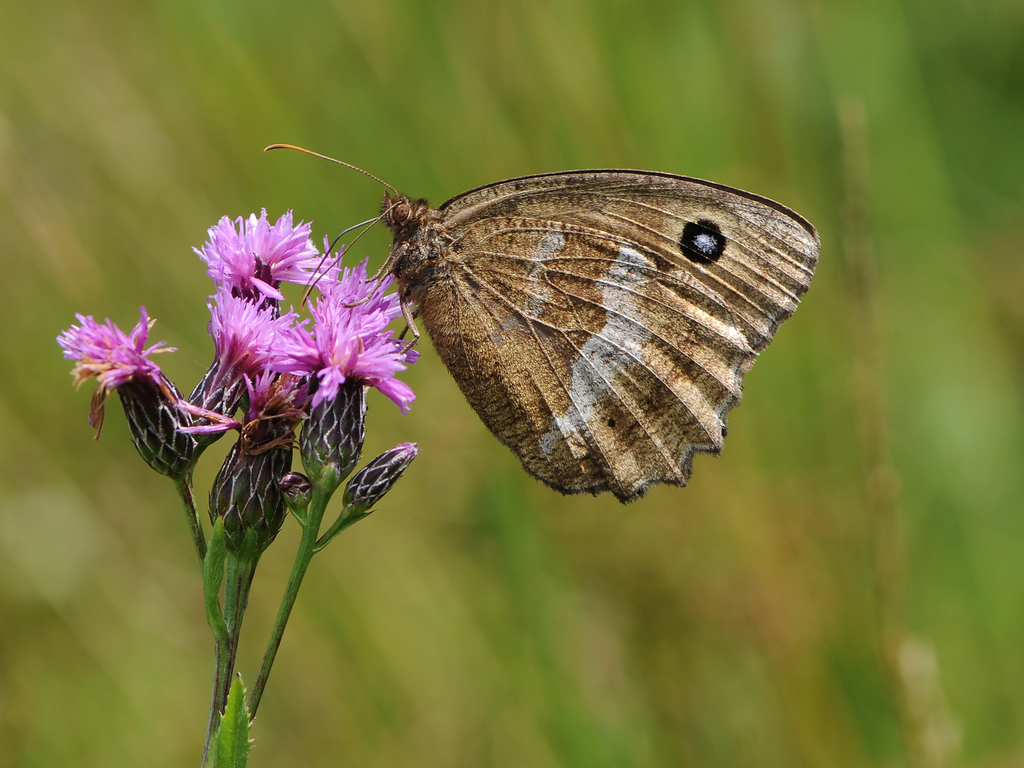
The Dryad butterfly has a wingspan of about 5.4 to 7 cm and dark brown upper wings with distinctive eye spots, two large bluish ones on each forewing and a small one on each hindwing. It lives on sunny woodland edges and flower-rich grasslands from low to mid elevations across southern and central Europe to Central Asia and Japan, feeding on nectar from tall flowers and its caterpillars on various grasses. Adults fly from June to September, and it can be confused with Satyrus actaea or Satyrus ferula, the latter having white-centered forewing eyespots.
Source: Wikipedia
How to recognize it
The upper side of the wings is dark brown with two large bluish eye spots on each forewing and a single small eye spot on each hindwing.
Source: Wikipedia
Size
Its wingspan ranges from 54 to 70 mm (about 2.1 to 2.8 inches).
Source: Wikipedia
Where it lives
It prefers sunny edges of mixed woodlands and flower-rich grasslands up to 1,600 m elevation.
Source: Wikipedia
What it eats
Adults feed on nectar of scabious, hemp agrimony and other tall flowers. Caterpillars eat a variety of grasses such as Molinia, Arrhenatherum, rice, oats, Dactylis, Poa, Festuca, Carex, Calamagrostis and Bromus.
Source: Wikipedia
Life cycle
Adults are on the wing from June through September, depending on location.
Source: Wikipedia
When you see it
The flight period spans June to September, varying with region.
Source: Wikipedia
Where it comes from
The species occurs from southern and central Europe across central Asia to Japan.
Source: Wikipedia
Lookalikes
It resembles Satyrus actaea and Satyrus ferula; the latter has forewing eyespots centered with white.
Source: Wikipedia
More photos


Same family (Nymphalidae)






Sources
- Wikipedia: https://en.wikipedia.org/wiki/Minois_dryas
Look it up elsewhere: GBIF · iNaturalist · BugGuide · Wikipedia
Text written 2026-10-22 from the sources above and checked sentence by sentence against them. Data fetched 2026-10-22.