 Bug FAQ
Druon ignotum
Druon ignotum · Order: Hymenoptera · Family: Cynipidae

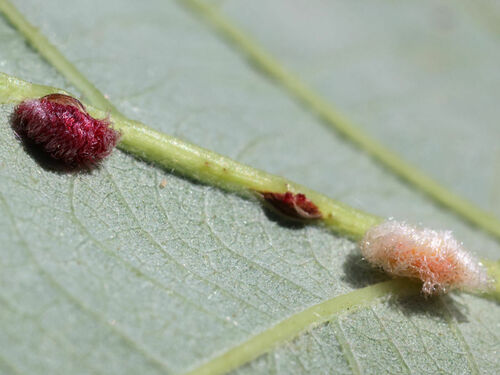
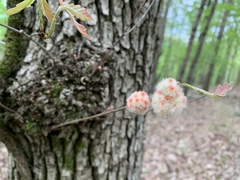
Adult females are covered in soft woolly hair that is cream- or pink-colored and turns brown in winter. The wasp has two generations each year, one sexual and one asexual, each making its own type of gall. Females emerge in early spring and lay eggs in oak buds, where the larvae cause the characteristic galls.
Source: Wikipedia
Life cycle
There are two generations per year, one asexual and one sexual, each producing distinct galls.
Source: Wikipedia
When you see it
Females emerge from galls early in spring and lay eggs in oak buds.
Source: Wikipedia
Where it comes from
The species is widespread across central and eastern North America.
Source: Wikipedia
Where it is found in the US
Recorded in 31 of 51 states and DC. Most records: Massachusetts, Minnesota, Illinois, New York, Wisconsin, Ohio, Virginia, Kansas.
Darker = more records. Counts are museum and citizen-science records, not population size.
Source: GBIF
Months it is reported in the US
Source: GBIF
More photos


Questions people ask
When do the adults appear?
Adult females emerge in early spring from the galls they formed the previous year.
Source: Wikipedia
How many generations does it have each year?
It has two generations annually, one sexual and one asexual, each making its own gall type.
Source: Wikipedia
Same family (Cynipidae)


Sources
- Wikipedia: https://en.wikipedia.org/wiki/Druon_ignotum
Look it up elsewhere: GBIF · iNaturalist · BugGuide · Wikipedia
Text written 2026-10-23 from the sources above and checked sentence by sentence against them. Data fetched 2026-10-22.