 Bug FAQ
Dilemma Orchid Bee
Euglossa dilemma · Order: Hymenoptera · Family: Apidae
Also called: Green Orchid Bee
Source: Wikipedia

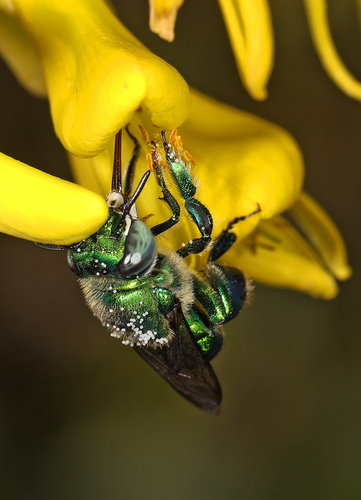
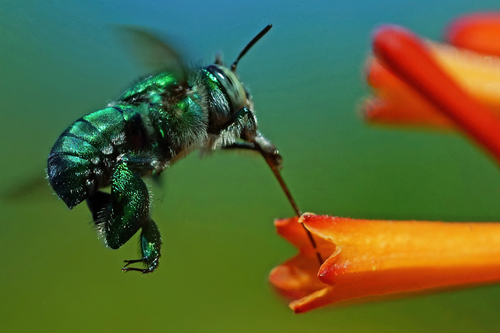
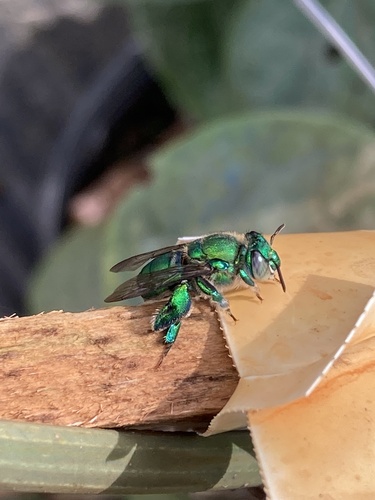
These orchid bees are glossy metallic green and about 1.3 cm long. Females build solitary nests of propolis with up to twenty cells and can sting mildly if handled.
Source: Wikipedia
How to recognize it
They shine in shades of metallic green and have dark translucent wings; females have pollen baskets on the hind legs, males have a special hind-leg joint for storing plant substances.
Source: Wikipedia
Size
Adults grow to about 1.3 cm (0.5 in) in length.
Source: Wikipedia
Does it bite or sting?
Only the female has a sting; it can be used repeatedly and is less painful than a honeybee sting.
Source: Wikipedia
Where it lives
In Mexico they live in hot, dry places such as degraded forests, pastures, parks and gardens. They are less dependent on primary forest than most orchid bees.
Source: Wikipedia
What it eats
Females collect pollen and nectar to feed their larvae, while both sexes sip nectar mainly from Ruellia brittoniana and Tecoma stans.
Source: Wikipedia
Life cycle
A female builds a solitary nest from plant resin (propolis) that can hold up to twenty cells, each with an egg. Several nests may be built side by side, but each female cares for her own brood alone.
Source: Wikipedia
Where it comes from
Their native range stretches from Costa Rica up through Mexico in Central America.
Source: Wikipedia
Lookalikes
They might be mistaken for sweat bees (Halictidae) like Augochloropsis, but orchid bees have a much longer proboscis for reaching deep flowers.
Source: Wikipedia
Where it is found in the US
Recorded in 1 of 51 states and DC. Most records: Florida.
Darker = more records. Counts are museum and citizen-science records, not population size.
Source: GBIF
Months it is reported in the US
Source: GBIF
More photos
Questions people ask
Do they sting?
Yes, the female can sting, but the pain is milder than that of a honeybee.
Source: Wikipedia
What do they look like?
They are glossy metallic green with dark translucent wings; females have pollen baskets on their hind legs.
Source: Wikipedia
Where are they found?
They live in hot, dry habitats like degraded forests, pastures, parks and gardens in Mexico and other parts of Central America.
Source: Wikipedia
What do they eat?
Both sexes drink nectar, especially from Ruellia brittoniana and Tecoma stans, and females also collect pollen for their larvae.
Source: Wikipedia
Same family (Apidae)


Sources
- Wikipedia: https://en.wikipedia.org/wiki/Euglossa_dilemma
Look it up elsewhere: GBIF · iNaturalist · BugGuide · ITIS · Wikipedia
Text written 2026-10-23 from the sources above and checked sentence by sentence against them. Data fetched 2026-10-23.