 Bug FAQ
Desert Grass Spider
Agelenopsis aperta · Order: Araneae · Family: Agelenidae
Source: Wikipedia

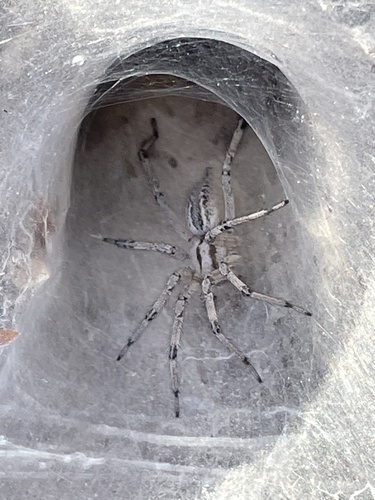
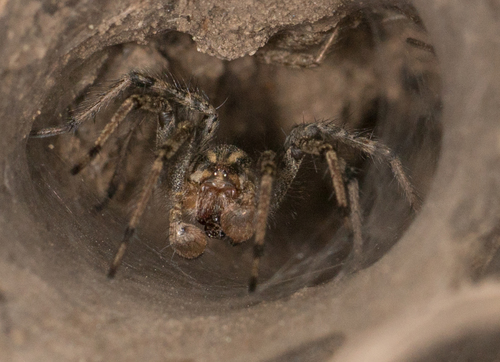
Desert grass spiders are 13 to 18 mm long, gray-brown-black in color, with a tan cephalothorax marked by two brown stripes and a tan abdomen with two black stripes. They spin funnel-shaped webs in crevices or inside homes and wait in the tube before running after prey with their long legs. Found in dry, arid areas of the southwestern United States and northwestern Mexico, they hunt at night and can survive very low temperatures.
Source: Wikipedia
How to recognize it
The spider’s body is gray, brown and black. Its front part (cephalothorax) is tan or gray with two brown stripes, and the abdomen is tan with two black stripes.
Source: Wikipedia
Size
The combined length of the cephalothorax and abdomen is about 13 to 18 mm.
Source: Wikipedia
Is it a pest in the house?
They are occasionally found inside homes or other buildings.
Source: Wikipedia
Does it bite or sting?
Bites to humans are considered harmless and not medically significant.
Source: Wikipedia
Where it lives
It builds funnel-shaped webs in crevices that fit the funnel, waiting in the tube before sprinting after prey. Individuals are sometimes found inside homes or other buildings in its range.
Source: Wikipedia
What it eats
It injects venom into insects, causing rapid paralysis.
Source: Wikipedia
Life cycle
Males are mainly monogamous and perform a courtship that includes swaying the abdomen and releasing pheromones. The male’s pheromones put the female into a cataplectic state, after which they mate when she becomes active again.
Source: Wikipedia
When you see it
They often hunt for prey at night. They can survive very low temperatures despite not cold-hardening.
Source: Wikipedia
Where it comes from
Its range includes the southwestern U.S., from southern California to Texas.
Source: Wikipedia
Where it is found in the US
Recorded in 12 of 51 states and DC. Most records: California, Colorado, Arizona, Texas, Nevada, New Mexico, Utah, Kansas.
Darker = more records. Counts are museum and citizen-science records, not population size.
Source: GBIF
Status: native in North America; native in United States. Source: iNaturalist
Months it is reported in the US
Source: GBIF
More photos


Questions people ask
Where do desert grass spiders live?
They are found in dry, arid regions of the southern United States and northwestern Mexico, especially the southwestern U.S. from southern California to Texas.
Source: Wikipedia
What do they look like?
They are gray-brown-black with a tan cephalothorax that has two brown stripes and a tan abdomen marked by two black stripes.
Source: Wikipedia
How big are they?
The combined length of their cephalothorax and abdomen is about 13 to 18 mm.
Source: Wikipedia
Same family (Agelenidae)


Sources
- Wikipedia: https://en.wikipedia.org/wiki/Agelenopsis_aperta
Look it up elsewhere: GBIF · iNaturalist · BugGuide · ITIS · Wikipedia
Text written 2026-10-24 from the sources above and checked sentence by sentence against them. Data fetched 2026-10-24.