 Bug FAQ
Hobo Spider
Eratigena agrestis · Order: Araneae · Family: Agelenidae
Source: Wikipedia, montana.edu, Utah State Extension

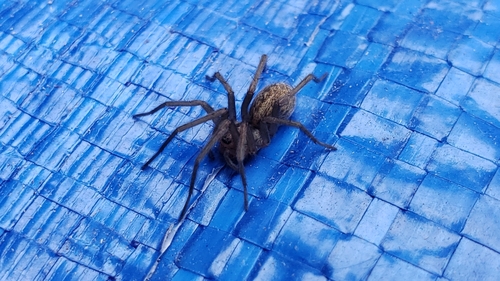
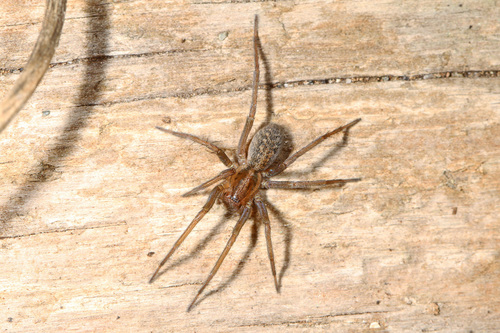
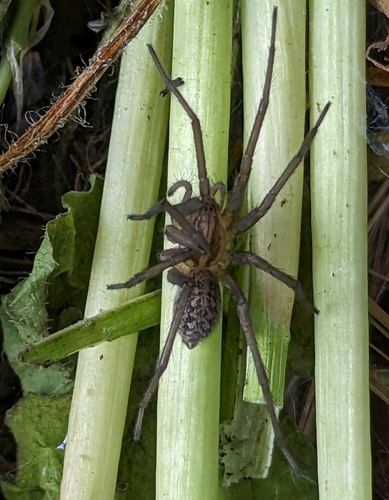
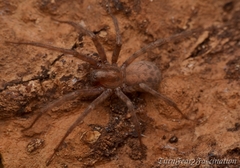
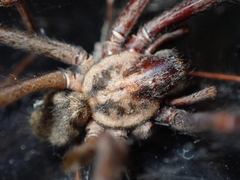
The hobo spider is a medium-sized spider about 7 to 14 mm long, with a brown front body, darker markings, and a grey abdomen marked by yellow chevron patterns. It builds a funnel-shaped web in dark, moist places such as basements or near brick walls, waiting at the funnel entrance for insects to fall in.
Source: Wikipedia, Utah State Extension, pestsense.cahnrs.wsu.edu
How to recognize it
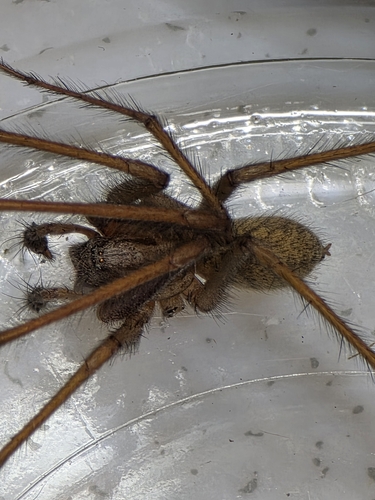
Unlike many Agelenidae, the hobo spider lacks colored bands at the leg joints. Its abdomen shows a series of V-shaped chevrons pointing toward the head. The front body (cephalothorax) is brown with darker brown markings, and the legs are also brown.
Source: Wikipedia, Utah State Extension
Size
Body length ranges from 7 to 14 mm.
Source: Wikipedia
Is it a pest in the house?
They may appear in basements because they cannot climb slick surfaces to escape. Males and females sometimes get trapped in clothing, bedding, or shoes on the floor. They are considered beneficial predators but can be a nuisance indoors.
Does it bite or sting?
Bites are rare and usually occur only when the spider feels threatened or is trapped. If bitten, bring the spider to an expert for identification and consider medical attention.
Source: montana.edu, Utah State Extension, pestsense.cahnrs.wsu.edu
How to get rid of it
Commercial spider traps can catch wandering hobo spiders. Pesticides give only temporary relief unless entry points are sealed. For identification help, contact local extension agents or the Schutter Diagnostic Lab in Montana.
Source: pestsense.cahnrs.wsu.edu, montana.edu
Where it lives
It prefers fields and avoids houses where larger house spiders dominate, but it can enter basements and other dark, damp areas. Webs are often built near brick walls or wood piles, forming a horizontal, trampoline-like sheet.
Source: Wikipedia, Utah State Extension
What it eats
The spider waits at the narrow end of its funnel web and captures insects that fall onto the silk sheet.
Source: Wikipedia
Life cycle
Eggs are laid in September and hatch in late spring. Males die after mating.
Source: Wikipedia
When you see it
Spiders, including hobo spiders, commonly enter buildings in late summer and early fall.
Source: montana.edu
Where it comes from
Its native range extends from Europe through Central Asia to the Pacific Northwest and Great Basin of North America. It has been recorded in Denmark and even on the artificial island of Peberholm, likely arriving via trains.
Source: Wikipedia
Lookalikes
Accurate identification requires microscopic examination of the spider’s genitalia by an arachnologist. The giant house spider looks similar and is often mistaken for the hobo spider. Other spiders with dark stripes, such as Agelenopsis, Hololena, and some wolf spiders, can also be confused with hobo spiders.
Source: Wikipedia, pestsense.cahnrs.wsu.edu, Utah State Extension
Where it is found in the US
Recorded in 10 of 51 states and DC. Most records: Colorado, Washington, Utah, Idaho, Oregon, Montana, Wyoming, Nevada.
Darker = more records. Counts are museum and citizen-science records, not population size.
Source: GBIF
Status: introduced in North America; introduced in United States; introduced in Canada. Source: iNaturalist
Months it is reported in the US
Source: GBIF
More photos
Questions people ask
Do hobo spiders bite?
They bite only when threatened or trapped, and the bite is mildly painful with only redness.
Source: montana.edu, Utah State Extension
How can I tell a hobo spider from a giant house spider?
You need a microscope to examine the genitalia; the giant house spider is a common look-alike.
Source: Wikipedia, pestsense.cahnrs.wsu.edu
Where do hobo spiders build their webs?
In dark, moist places like basements, near brick walls or wood piles, forming a funnel-shaped sheet.
Source: pestsense.cahnrs.wsu.edu, Wikipedia
What should I do if I find hobo spiders in my home?
Use spider traps and seal entry points; for identification or larger problems, contact your local extension service.
Source: pestsense.cahnrs.wsu.edu, montana.edu
Same family (Agelenidae)


Sources
- Wikipedia: https://en.wikipedia.org/wiki/Hobo_spider
- montana.edu: https://www.montana.edu/extension/ipm/entomology/resources/fact-sheets/hobo-spiders.html
- Utah State Extension: https://extension.usu.edu/planthealth/research/hobo-spiders
- pestsense.cahnrs.wsu.edu: https://pestsense.cahnrs.wsu.edu/fact-sheet/hobo-spider/
Look it up elsewhere: GBIF · iNaturalist · BugGuide · ITIS · Wikipedia
Text written 2026-10-23 from the sources above and checked sentence by sentence against them. Data fetched 2026-10-23.