 Bug FAQ
Giant House Spider
Eratigena atrica · Order: Araneae · Family: Agelenidae
Also called: House Spider
Source: Wikipedia, pestsense.cahnrs.wsu.edu
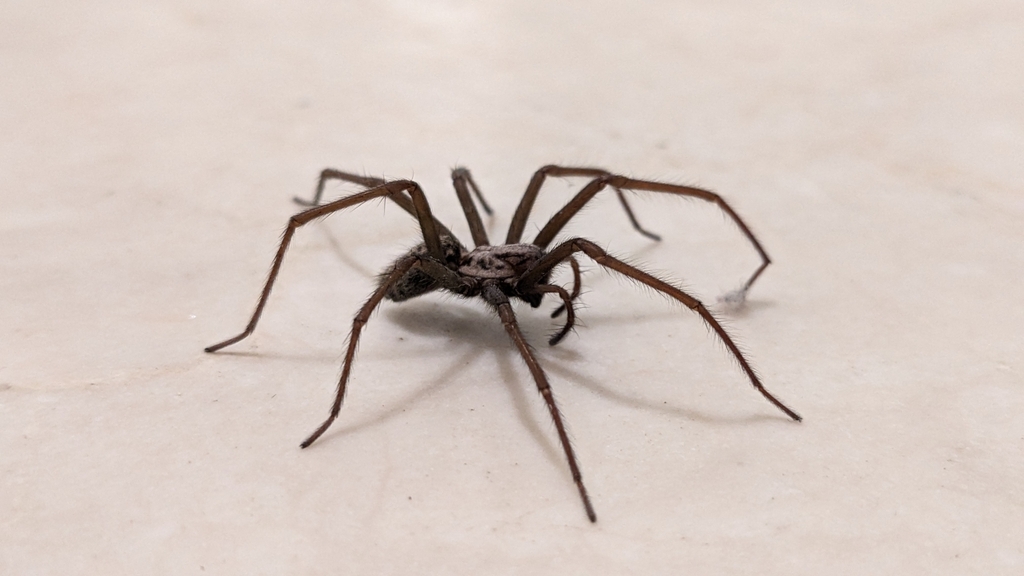
Giant house spiders are dark-brown, have a lighter arrow-shaped marking on the sternum and a light line with spots on the abdomen, and their legs and body are hairy rather than shiny. Females reach about 18 mm in body length with a leg span near 45 mm; males are smaller (12 to 15 mm) but can have leg spans from 25 to 75 mm. They originally lived in caves and dry forests but now commonly occupy dark, hidden spots in homes such as basements, garages, behind furniture, and window openings.
Source: Wikipedia, pestsense.cahnrs.wsu.edu
How to recognize it
The spider is mainly dark-brown with a lighter arrow-shaped pattern of three spots on each side of the sternum and a lighter central line with six spots on each side of the abdomen. Its legs and body are somewhat hairy and lack a shiny appearance.
Source: Wikipedia, pestsense.cahnrs.wsu.edu
Size
Female body length can reach 18.5 mm, while males are slightly smaller at 12 to 15 mm. Female leg span is typically about 45 mm; male leg spans vary widely, commonly between 25 and 75 mm.
Source: Wikipedia
Is it a pest in the house?
They are frequently found near open windows and in garages, basements, firewood piles, or gaps between bricks and stones. The species prefers dark areas for building its web and is well adapted to indoor life.
Source: Wikipedia, pestsense.cahnrs.wsu.edu
Does it bite or sting?
Its fangs can get through human skin. The usual reaction is local pain and swelling. The bite is not considered a threat to humans or pets. If bitten, it is advisable to bring the spider to an expert for identification and consider medical attention.
Source: Wikipedia, pestsense.cahnrs.wsu.edu
How to get rid of it
Inside homes, control is best done mechanically, such as by removing webs and sealing entry points. Chemical or extensive outdoor control is not recommended or realistic.
Source: pestsense.cahnrs.wsu.edu
Where it lives
Originally found in caves and dry forests under rocks, the species now commonly lives in human homes. Inside buildings it prefers dark, hidden places such as basements, behind or under furniture, and inside walls.
Source: Wikipedia
What it eats
The spider uses venom to subdue prey. It waits in its funnel web and rushes out to capture small invertebrates that become trapped.
Source: Wikipedia
Life cycle
Adults usually live two to three years, but some may survive up to six years. An egg sac releases at least 60 spiderlings that stay together for about a month before dispersing.
Source: Wikipedia
When you see it
Males are most often seen from July to October, wandering in late summer and early autumn in search of mates. Adult females can be found throughout the year.
Source: Wikipedia
Where it comes from
It is native to Europe, Central Asia and Northern Africa.
Source: Wikipedia
Lookalikes
It shares coloration with the domestic house spider, showing earthy brown and muddy-red or yellow tones. It is often mistaken for the smaller hobo spider; males especially can be confused with hobo spiders.
Source: Wikipedia, pestsense.cahnrs.wsu.edu
Where it is found in the US
Recorded in 3 of 51 states and DC. Most records: Colorado, Montana, Oregon.
Darker = more records. Counts are museum and citizen-science records, not population size.
Source: GBIF
Status: introduced in Canada; introduced in United States. Source: iNaturalist
Questions people ask
Do giant house spiders bite?
It can, if provoked. The usual reaction is local pain and swelling, and the bite is not known to be a threat to people.
Source: Wikipedia, pestsense.cahnrs.wsu.edu
How can I get rid of them indoors?
Use mechanical methods like removing webs, sealing cracks, and reducing clutter where they hide.
Source: pestsense.cahnrs.wsu.edu
Where are giant house spiders usually found in a house?
They like dark, hidden spots such as basements, garages, behind furniture, and near open windows.
Source: Wikipedia, pestsense.cahnrs.wsu.edu
Same family (Agelenidae)

Sources
- Wikipedia: https://en.wikipedia.org/wiki/Giant_house_spider
- pestsense.cahnrs.wsu.edu: https://pestsense.cahnrs.wsu.edu/fact-sheet/giant-house-spider/
Look it up elsewhere: GBIF · iNaturalist · BugGuide · ITIS · Wikipedia
Text written 2026-10-23 from the sources above and checked sentence by sentence against them. Data fetched 2026-10-23.