 Bug FAQ
Labyrinth spider
Agelena labyrinthica · Order: Araneae · Family: Agelenidae
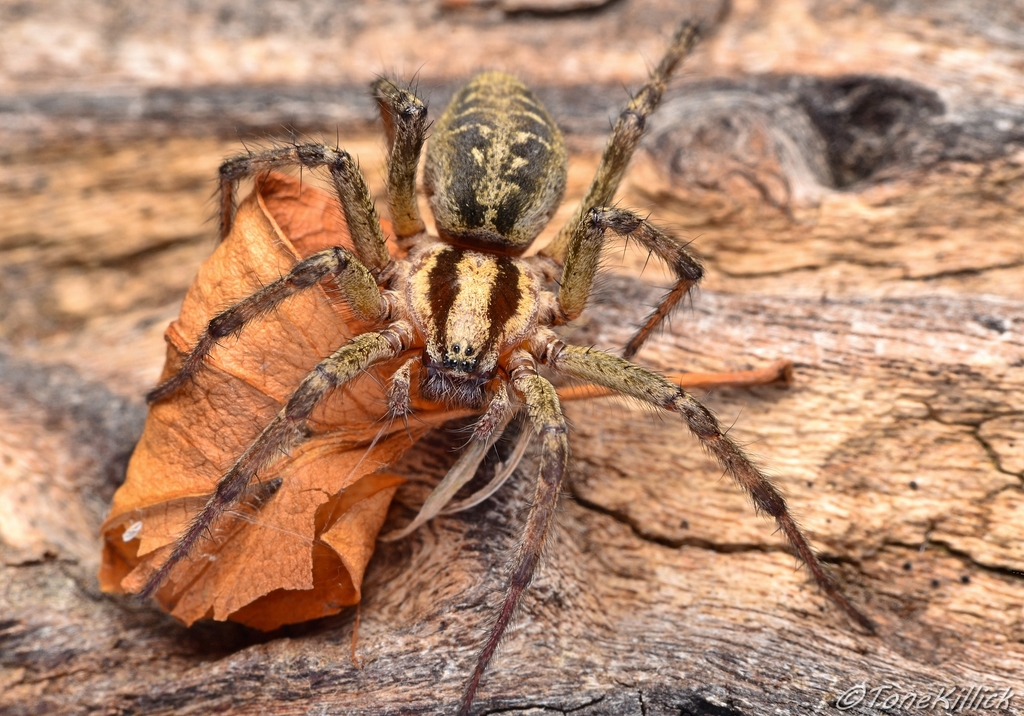
The labyrinth spider can grow up to 18 mm long and has a dark abdomen with a pale central band and white chevron marks, plus a yellow-brown cephalothorax with two front longitudinal stripes. It builds flat sheet webs with funnel-shaped retreats among low grass and vegetation in Europe and parts of Central and East Asia. Mating occurs in mid-July, and the young overwinter on stored egg yolk before emerging in spring.
Source: Wikipedia
How to recognize it
The cephalothorax is yellow-brown with two broad stripes toward the front.
Source: Wikipedia
Where it lives
They are common in Europe, especially near forests, low vegetation, and dry grasslands. Their webs are flat sheets with funnel retreats placed between low grass and plants.
Source: Wikipedia
What it eats
They practice matriphagy, where the mother is consumed by the offspring. Sensitive hairs called trichobothria help them detect prey quickly and accurately.
Source: Wikipedia
Life cycle
Mating begins around mid-July each year. Spiderlings survive the winter on yolk stored in their abdomens and emerge in the following spring.
Source: Wikipedia
When you see it
The main mating period is in mid-July. Young spiders overwinter on yolk reserves and become active in spring.
Source: Wikipedia
Where it comes from
Their range covers most of Europe and extends into Central and East Asia, including Mongolia, China, Korea, and Japan.
Source: Wikipedia
Lookalikes
Their venom glands consist of paired structures in the abdomen, a trait they share with some Loxosceles species.
Source: Wikipedia
More photos

Same family (Agelenidae)

Sources
- Wikipedia: https://en.wikipedia.org/wiki/Agelena_labyrinthica
Look it up elsewhere: GBIF · iNaturalist · BugGuide · ITIS · Wikipedia
Text written 2026-10-22 from the sources above and checked sentence by sentence against them. Data fetched 2026-10-22.