 Bug FAQ
Delta Flower Scarab
Trigonopeltastes delta · Order: Coleoptera · Family: Scarabaeidae
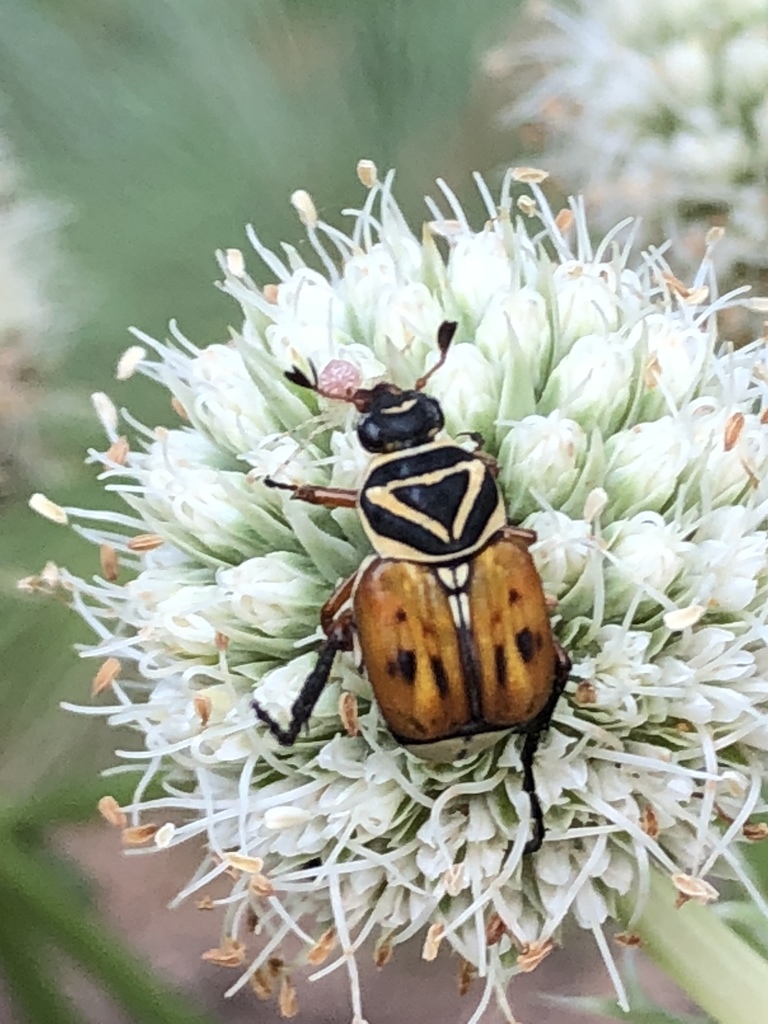
Adults are about 8-10 mm long and have a distinctive yellow triangle on the pronotum that mimics wasp coloration. The species is thought to be a Batesian mimic, copying the warning colors of stinging insects.
Source: Wikipedia
How to recognize it
A yellow triangular mark on the pronotum makes it look like a wasp.
Source: Wikipedia
Size
Adults measure about 8-10 mm in length.
Source: Wikipedia
Where it lives
They are found on flowers during late spring to summer.
Source: Wikipedia
When you see it
Active from late spring through the summer.
Source: Wikipedia
Where it comes from
Native to the southeastern United States, with the range reaching as far north as New Jersey.
Source: Wikipedia
Lookalikes
Its coloration is believed to be Batesian mimicry of stinging insects.
Source: Wikipedia
Where it is found in the US
Recorded in 23 of 51 states and DC. Most records: Florida, Texas, North Carolina, Virginia, South Carolina, Georgia, Louisiana, Alabama.
Darker = more records. Counts are museum and citizen-science records, not population size.
Source: GBIF
Status: native in North America; native in United States. Source: iNaturalist
Months it is reported in the US
Source: GBIF
More photos

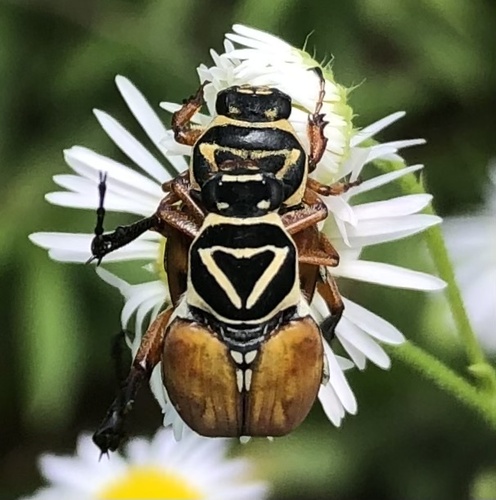
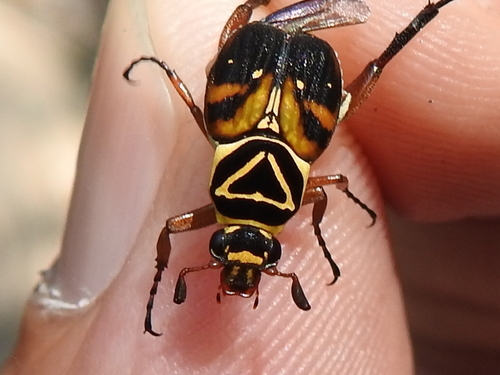
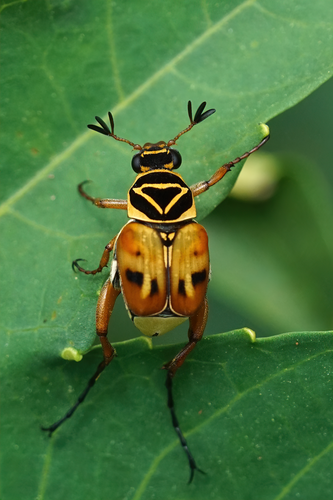
Questions people ask
How can I tell a Delta Flower Scarab apart from other beetles?
Look for the small size (8-10 mm) and the yellow triangle on the pronotum that mimics a wasp.
Source: Wikipedia
When am I most likely to see these beetles?
They are most common from late spring through the summer on flowering plants.
Source: Wikipedia
Why do they have a wasp-like color pattern?
The yellow triangle is thought to be Batesian mimicry, copying the warning colors of stinging insects.
Source: Wikipedia
Same family (Scarabaeidae)
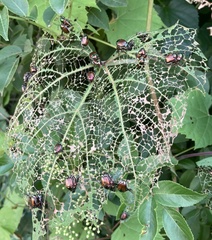 Japanese BeetlePopillia japonicaDamages trees, gardens or crops
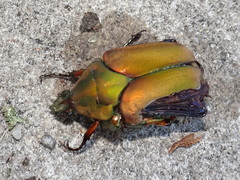 Common Green June BeetleCotinis nitidaDamages trees, gardens or crops
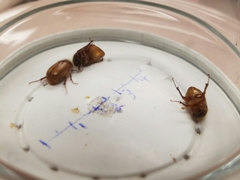 Phyllophaga crinitaPhyllophaga crinitaDamages trees, gardens or crops
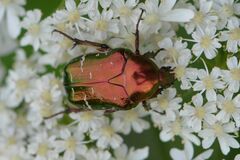 European Rose ChaferCetonia aurata
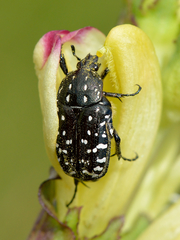 Mediterranean Spotted ChaferOxythyrea funestaDamages trees, gardens or crops
 Oriental BeetleExomala orientalisDamages trees, gardens or crops
Sources
- Wikipedia: https://en.wikipedia.org/wiki/Trigonopeltastes_delta
Look it up elsewhere: GBIF · iNaturalist · BugGuide · ITIS · Wikipedia
Text written 2026-10-22 from the sources above and checked sentence by sentence against them. Data fetched 2026-10-22.