 Bug FAQ
Dark Blue Tiger
Tirumala septentrionis · Order: Lepidoptera · Family: Nymphalidae
Also called: Dark Blue Tiger Butterfly
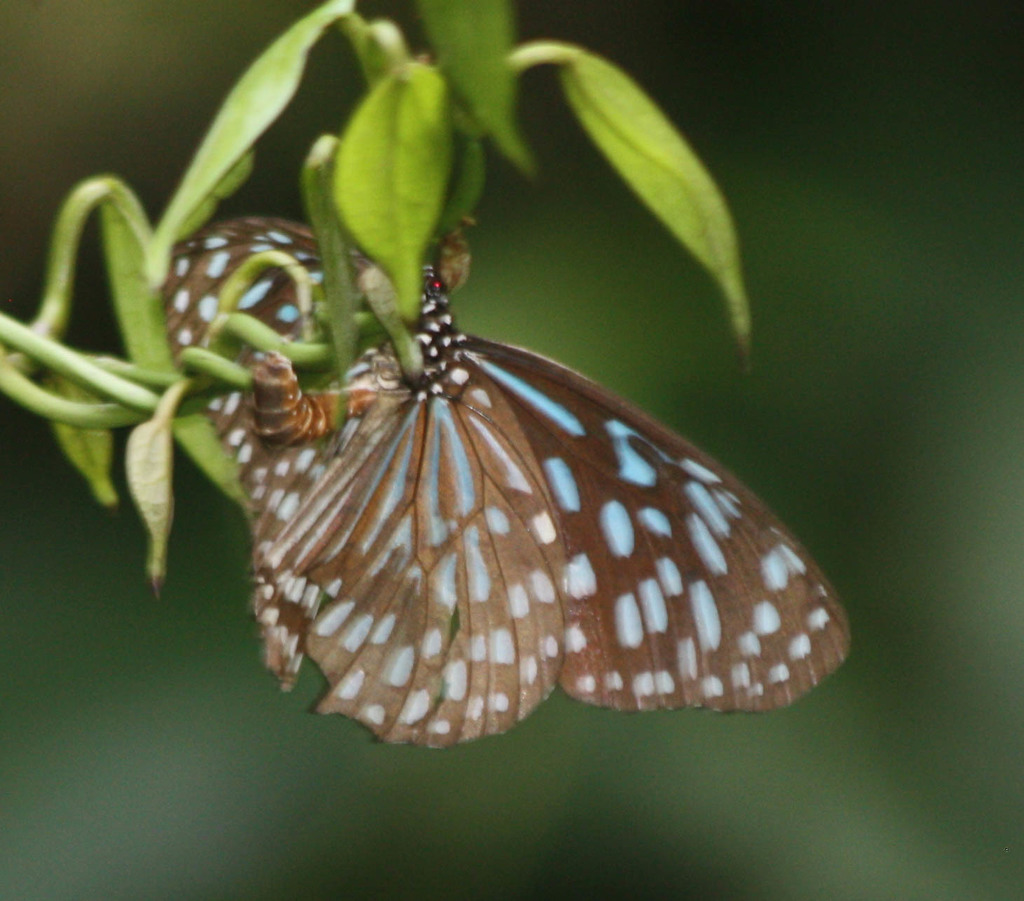
The dark blue tiger butterfly has a wingspan of about 80 to 115 mm and is darker on the upperside than the similar T. limniace, with narrower, bluish semi-transparent markings. It is a common migratory species in southern India, making up roughly 78 % of the butterfly population during the migration season. Its range covers the Indian subcontinent and parts of Southeast Asia, from the Himalayas through the Western Ghats, Nilgiris, Sri Lanka and into Myanmar, Cambodia and beyond.
Source: Wikipedia
How to recognize it
Compared with T. limniace, the dark blue tiger’s upperside is darker and its semi-transparent markings are narrower, more distinct and have a bluish tint. Wing patterns can vary widely due to genetics.
Source: Wikipedia
Size
Its wingspan ranges from 80 to 115 mm.
Source: Wikipedia
Where it lives
During the migratory season in southern India it dominates the butterfly community, accounting for about 78 % of individuals.
Source: Wikipedia
What it eats
Caterpillars feed on Vallaris dichotoma, as reported by MacKinnon and de Nicéville. Other recorded host plants include Cosmostigma racemosa, Heterostemma brownii and species of Cocculus.
Source: Wikipedia
Life cycle
The caterpillar looks similar to that of T. limniace. Its larvae also feed on Vallaris dichotoma.
Source: Wikipedia
When you see it
It is a dominant species during the migration season in southern India, making up about 78 % of the butterfly population.
Source: Wikipedia
Where it comes from
It is found across the Indian subcontinent and Southeast Asia, including the Himalayas, Assam, Myanmar, Cambodia, the Western Ghats, Nilgiris, Sri Lanka and other regions.
Source: Wikipedia
Same family (Nymphalidae)






Sources
- Wikipedia: https://en.wikipedia.org/wiki/Tirumala_septentrionis
Look it up elsewhere: GBIF · iNaturalist · BugGuide · Wikipedia
Text written 2026-10-22 from the sources above and checked sentence by sentence against them. Data fetched 2026-10-22.