 Bug FAQ
Danaid Eggfly
Hypolimnas misippus · Order: Lepidoptera · Family: Nymphalidae
Also called: Common Diadem, False Plain Tiger, Mimic Diadem, mimic butterfly
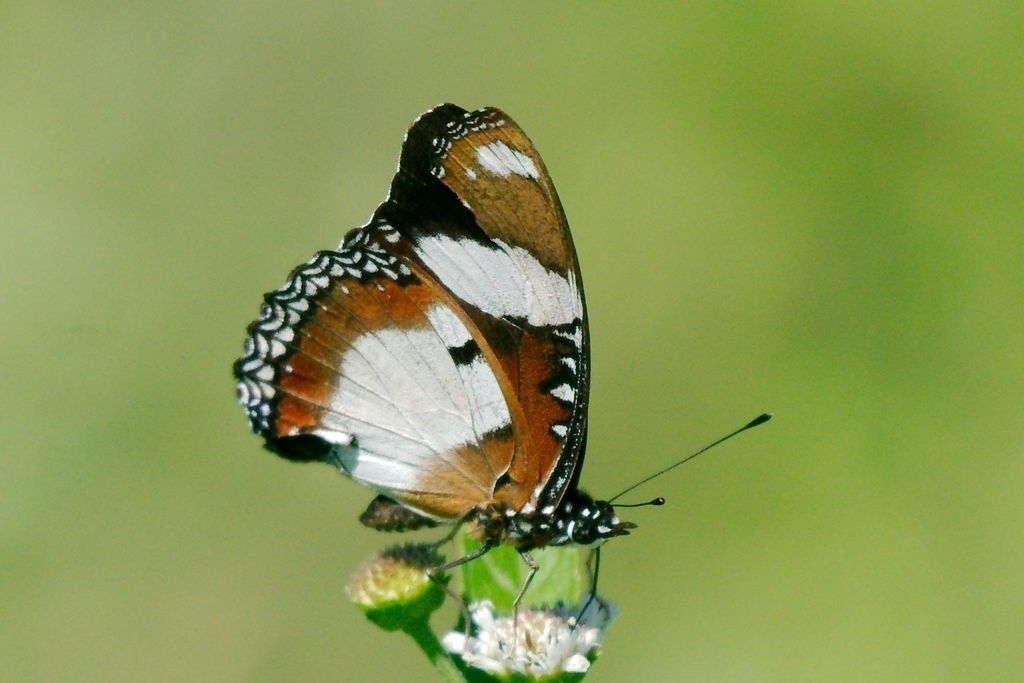
Male Danaid Eggflies are dark brownish-black on the upper wings with white spots edged in blue, and they look the same across individuals. They live across Africa, Asia, Australia and many Indian Ocean islands, and occasionally appear in the West Indies and as strays in Central and North America. Caterpillars feed on purslane and Asystasia leaves, while adults are active in late afternoon after rain; they fly in late summer (March-April) and are rare in dry weather.
Source: Wikipedia
How to recognize it
Males are uniformly dark velvety brown-black on the upper wings with distinctive white spots that have blue edges.
Source: Wikipedia
Where it lives
They are found throughout Africa, Asia, Australia and many islands in the Indian Ocean such as the Maldives, Seychelles, Mahé, Praslin, Aldabra and Cousine.
Source: Wikipedia
What it eats
Larvae feed on the leaves of common purslane (Portulaca oleracea) and Asystasia lawiana. Adult males are most active in the late afternoon after rain.
Source: Wikipedia
Life cycle
The caterpillar is cylindrical, mostly black with a darker black line along its back. The pupa hangs loosely, is short and thick, and its shape helps it blend in.
Source: Wikipedia
When you see it
Adults are on the wing in late summer, mainly March to April, and are rarely seen during dry periods.
Source: Wikipedia
Where it comes from
Their native range includes Africa, Asia and Australia, and they also occur in the West Indies with occasional strays into Central and North America.
Source: Wikipedia
Lookalikes
Female Danaid Eggflies can look like males or mimic the toxic Danaus chrysippus (Plain Tiger) and Danaus plexippus (Monarch).
Source: Wikipedia
Where it is found in the US
Recorded in 6 of 51 states and DC. Most records: Florida, Texas, Georgia, Ohio, South Carolina, Connecticut.
Darker = more records. Counts are museum and citizen-science records, not population size.
Source: GBIF
Status: native in North America. Source: iNaturalist
Months it is reported in the US
Source: GBIF
Questions people ask
Are they a garden pest?
The larvae feed on purslane and Asystasia leaves, but there is no source indicating they damage crops or garden plants.
Source: Wikipedia
Same family (Nymphalidae)






Sources
- Wikipedia: https://en.wikipedia.org/wiki/Hypolimnas_misippus
Look it up elsewhere: GBIF · iNaturalist · BugGuide · ITIS · Wikipedia
Text written 2026-10-22 from the sources above and checked sentence by sentence against them. Data fetched 2026-10-22.