 Bug FAQ
Crimson Rose Swallowtail
Pachliopta hector · Order: Lepidoptera · Family: Papilionidae
Also called: Crimson Rose
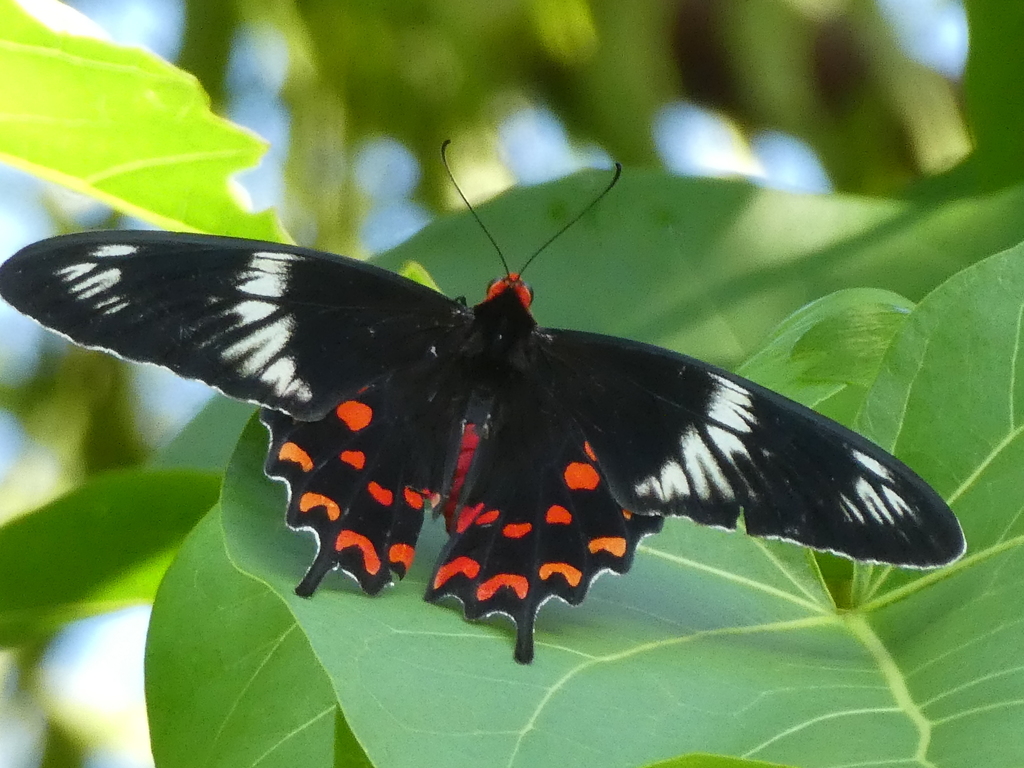
The male Crimson Rose Swallowtail has a black upper side, black antennae, thorax and base of the abdomen. It lives in jungles and open country up to 2400 m in South India and is found year-round at lower elevations. The caterpillars feed on Aristolochia species and the adults love flowers such as Lantana.
Source: Wikipedia
How to recognize it
The forewing has a broad white broken band from the subcostal nervure near veins 10-11 to the tornus, plus a short pre-apical band made of irregular streaks.
Source: Wikipedia
Size
The male's upper side is black. Antennae, thorax and the base of the upper abdomen are black.
Source: Wikipedia
Where it lives
It inhabits both jungle and open country. During the dry season it can be found up to 2400 m in South India, but lives at lower elevations all year.
Source: Wikipedia
What it eats
Larvae feed on several Aristolochia species such as A. indica, A. bracteolata and Thottea siliquosa. Adults are attracted to flowers, especially Lantana.
Source: Wikipedia
Life cycle
They can breed up to seven times a year and develop from egg to adult in 39 to 47 days. Caterpillars may exhibit cannibalistic behaviour.
Source: Wikipedia
When you see it
Higher numbers are seen from August to November and from April to June. At night they often roost in large groups on tree and shrub branches.
Source: Wikipedia
Where it comes from
It occurs in Pakistan, India, Sri Lanka, the Maldives and possibly western Myanmar. In India it is present in the Western Ghats, southern states (Tamil Nadu, Kerala) and eastern states (West Bengal, Odisha).
Source: Wikipedia
Lookalikes
It is inedible and rarely attacked by predators, a trait shared with its mimics. A female form of the common Mormon (Papilio polytes) mimics this butterfly.
Source: Wikipedia
More photos

Same family (Papilionidae)
Sources
- Wikipedia: https://en.wikipedia.org/wiki/Pachliopta_hector
Look it up elsewhere: GBIF · iNaturalist · BugGuide · Wikipedia
Text written 2026-10-23 from the sources above and checked sentence by sentence against them. Data fetched 2026-10-22.