 Bug FAQ
Cosmodela batesi
Cosmodela batesi · Order: Coleoptera · Family: Carabidae

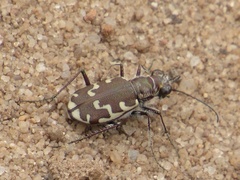
Cosmodela batesi is a tiger beetle about 15 to 21 mm long with a metallic blue-green body and flashes of yellow, orange and red. Each elytron bears four white spots, the one nearest the thorax being the smallest. It lives in low-to-mid-altitude mountains below 1000 m, is endemic to Taiwan, hunts small insects on open ground, and its larvae wait in burrows to catch passing prey.
Source: Wikipedia
How to recognize it
The beetle’s body is mainly metallic blue-green with shades of yellow, orange and red.
Source: Wikipedia
Size
Adults measure between 15 and 21 mm in length.
Source: Wikipedia
What it eats
Adults run on open ground hunting small insects. Larvae stay in burrows and ambush passing insects.
Source: Wikipedia
Life cycle
The larval stage has three instars; the first two together last about four weeks and the third about six months. Third-instar larvae plug their burrow entrances with soil, likely to keep out rain or predators.
Source: Wikipedia
When you see it
Mating occurs from May through August.
Source: Wikipedia
Where it comes from
Cosmodela batesi is endemic to Taiwan.
Source: Wikipedia
More photos


Questions people ask
What does Cosmodela batesi look like?
It is a 15 to 21 mm tiger beetle with a metallic blue-green body, yellow-orange-red highlights, and four white spots on each elytron, the nearest spot being the smallest.
Source: Wikipedia
Where is this beetle found?
It lives in low-to-mid-altitude mountains below 1000 m and is endemic to Taiwan.
Source: Wikipedia
What does it eat?
Adults hunt small insects on open ground, while larvae wait in burrows to catch passing insects.
Source: Wikipedia
Same family (Carabidae)



Sources
- Wikipedia: https://en.wikipedia.org/wiki/Cosmodela_batesi
Look it up elsewhere: GBIF · iNaturalist · BugGuide · Wikipedia
Text written 2026-10-23 from the sources above and checked sentence by sentence against them. Data fetched 2026-10-22.